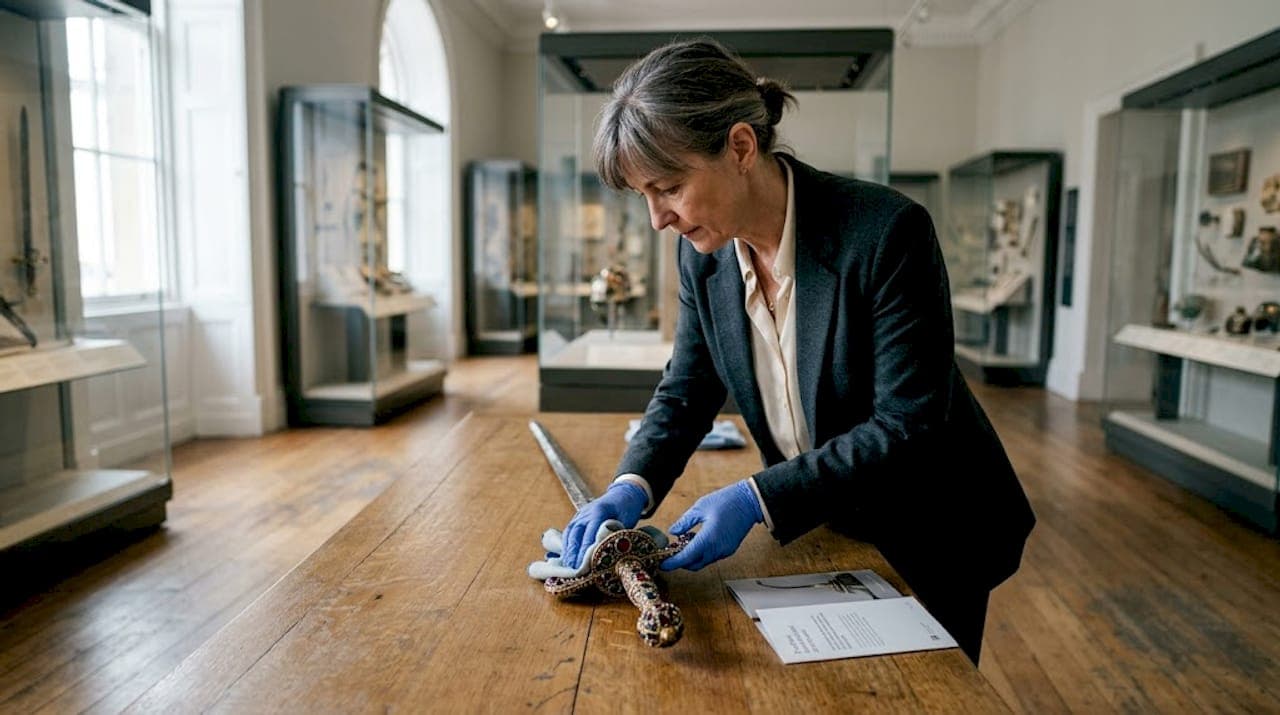
Not every sword was made to draw blood. Yet many collectors walk into the world of ceremonial swords expecting the same standards they'd apply to a battle blade, and they end up missing what makes these pieces genuinely extraordinary. Ceremonial swords exist in a category all their own, built to communicate power, honor, and artistry rather than deliver a killing blow. This guide breaks down what defines a ceremonial sword, why their history matters, how the finest examples are made, and exactly how you should display and care for them as a collector.
Table of Contents
- What makes a sword ceremonial?
- Historical significance and symbolism
- How ceremonial swords are crafted
- Displaying and preserving ceremonial swords
- The truth most collectors miss about ceremonial swords
- Explore unique ceremonial swords for your collection
- Frequently asked questions
Key Takeaways
| Point | Details |
|---|---|
| Ceremonial vs. battle swords | Ceremonial swords are designed for display and symbolism, not combat performance. |
| Symbolism matters | The historical context and decorative details often carry deep symbolic meaning. |
| Craftsmanship elevates value | Artisans use premium materials and techniques making ceremonial swords especially collectible. |
| Proper display and care | Displaying and preserving ceremonial swords protects their value and visual appeal. |
| Collecting insights | Collectors should prioritize authenticity, craftsman quality, and historical significance. |
What makes a sword ceremonial?
The simplest way to separate a ceremonial sword from a combat sword is to ask: what was this object built to communicate? A battle sword is engineered for edge retention, balance in the hand, and structural integrity under impact. A ceremonial sword is engineered to be seen, admired, and understood as a symbol.
That shift in purpose changes everything about the design process. Blade geometry, for example, is no longer driven by cutting mechanics. Instead, blades may be wider, more ornate, or made from softer metals that hold a polished finish better than high-carbon steel. The guard and pommel, which serve grip and balance functions on a fighting sword, become canvases for goldsmithing and gem setting. The scabbard transforms from a simple carrying case into an art object.
Decorated parade-oriented pieces are typically unsuitable for battlefield use and highlight power, wealth, and culture. That's not a flaw. That's the point.
Common occasions when ceremonial swords are used:
- Military parades and formal reviews
- Coronation and royal investiture ceremonies
- Knighthood and orders of chivalry rituals
- Academic and judicial award presentations
- Religious and cultural festivals
- Diplomatic gift giving between heads of state
When you're identifying quality swords in this category, the metrics shift. You're looking at finish quality, the precision of engraving, the materials used in decorative inlay, and the overall compositional balance of the piece as a visual object.
| Feature | Ceremonial sword | Combat sword |
|---|---|---|
| Primary goal | Symbolism and aesthetics | Functionality and durability |
| Blade material | Polished steel, bronze, gold plating | High-carbon or Damascus steel |
| Edge sharpness | Often blunt or decorative | Sharp, battle-ready |
| Handle decoration | Engraved, gem-set, gilded | Practical grip, minimal decoration |
| Weight distribution | Optimized for appearance | Optimized for fighting balance |
| Scabbard | Ornately decorated | Functional, protective |
"A ceremonial sword tells you more about a civilization's values than any battlefield weapon ever could. It is the sword made not to end life, but to define it."
Historical significance and symbolism
Once you understand how these swords differ from combat blades, the deeper question becomes: why did so many cultures across history invest such tremendous resources into making them?
The answer comes down to the universal human need to visualize authority. A king holding an ornate, jewel-encrusted sword at his coronation isn't just carrying a weapon. He's holding a physical argument for why he rules. The sword becomes a prop in a political and cultural performance designed to make power feel legitimate, ancient, and sacred.
Ceremonial swords were designed for parades and ceremonial occasions where beauty expresses power, wealth, or cultural values. This pattern appears across dramatically different civilizations, which tells you something important about how humans think.
Key cultures and traditions in ceremonial sword history:
- Medieval Europe. Knights received swords during dubbing ceremonies as part of their formal entry into chivalric orders. The sword symbolized the responsibility to protect the weak and serve the crown. Many of these pieces survive today in cathedral treasuries and royal collections.
- Feudal Japan. The katana occupied a ceremonial role beyond combat. Sword-presenting rituals (known as tachi presentation) marked military promotions and political alliances. The sword itself was considered spiritually alive.
- Ottoman Empire. Turkish sultans commissioned extraordinary parade swords called kılıç with blades inlaid in gold and hilts set with rubies and emeralds. These pieces were as much diplomatic currency as they were symbols of personal power.
- Ancient Egypt. Pharaohs carried ceremonial khopesh swords in processions and rituals, connecting the ruler to divine protection and military authority even when no actual war was being fought.
- British Royal Tradition. The Sword of State and Sword of Mercy used at British coronations date back centuries. Each sword in the coronation regalia carries a specific symbolic meaning, from mercy to temporal justice to spiritual authority.
| Culture | Period | Symbolic meaning |
|---|---|---|
| Medieval Europe | 9th to 15th century | Chivalry, divine right, protection |
| Feudal Japan | 12th to 19th century | Honor, spiritual power, rank |
| Ottoman Empire | 14th to 20th century | Wealth, conquest, divine favor |
| Ancient Egypt | 3000 to 30 BCE | Divine protection, royal authority |
| British Crown | 11th century to present | Justice, mercy, temporal power |
For collectors building a serious collection, understanding this symbolic dimension is not optional background reading. It's the framework that determines which pieces are genuinely meaningful versus which are just decorative objects. Browse the essential collectible swords worth knowing if you're building a collection with historical depth.
If you're interested specifically in European pieces, a solid knowledge of buying medieval ceremonial swords will help you ask better questions and avoid common purchasing mistakes.
How ceremonial swords are crafted
Looking at history and meaning, it becomes even more impressive to see the level of skill invested in making these works of art. The creation of a high-quality ceremonial sword was never a single craftsman's job. It required collaboration between specialists who rarely overlapped on battlefield weapons.
Materials commonly used in ceremonial sword construction:
- Polished stainless steel or bronze for blades where a mirror finish matters more than edge hardness
- Gold and silver plating or inlay applied to blade fullers, ricasso sections, and decorative panels
- Precious and semi-precious stones including rubies, emeralds, sapphires, and pearls set into pommels and cross-guards
- Ivory, bone, or exotic hardwoods used for grip materials, often carved into elaborate shapes
- Enamel work fused into recessed panels on guards and pommels for vivid color accents
- Wire wrapping in gold or silver used to create texture and visual interest on the grip
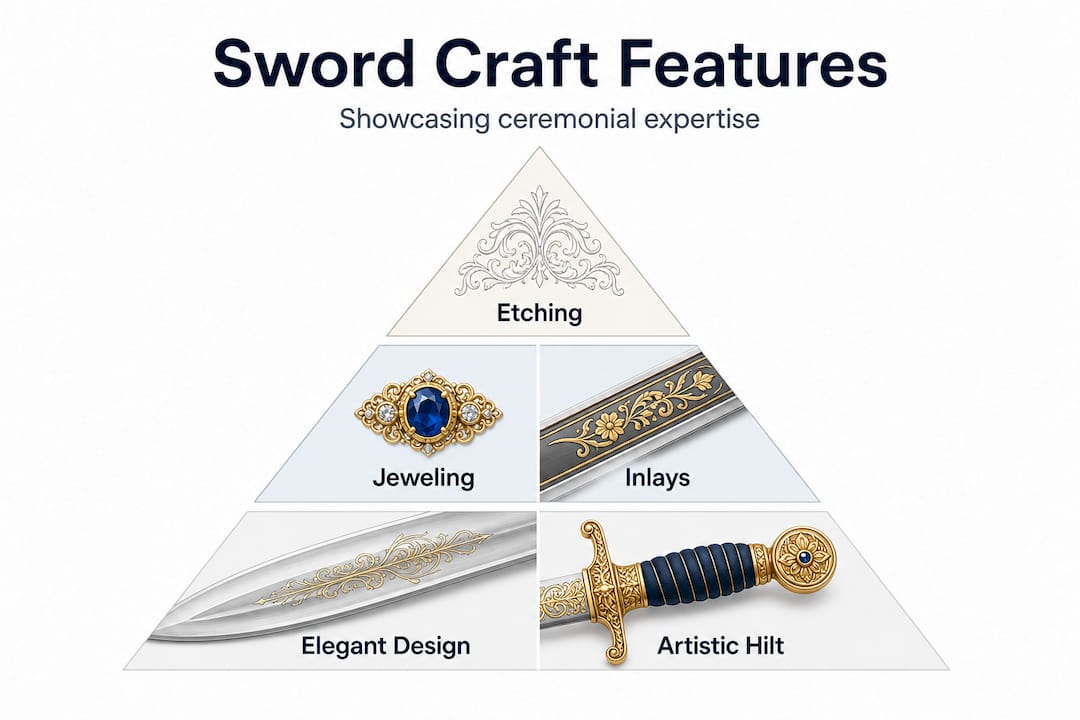
The techniques involved go well beyond standard blacksmithing. Etching uses acid to bite decorative patterns into the blade surface. Engraving cuts directly into metal with specialized gravers to create fine detail. Gilding applies thin gold leaf or gold solution to metallic surfaces and requires precise temperature and adhesion control. Damascening, a technique borrowed from Middle Eastern tradition, inlays precious metals directly into steel or iron using a cross-hatched undercut that mechanically locks the inlay in place.
Ceremonial swords highlight intricate crafts and are made to express beauty, not battle readiness. This means a piece can take months to produce even when the underlying blade is structurally simple.

Pro Tip: When evaluating a ceremonial sword for purchase, look closely at the junction between decorative elements and the underlying metal. Clean, precise inlay with no lifting edges or gaps indicates skilled artisan work. Rough seams or visible adhesive under plating are warning signs of low-quality production.
The collaboration between blacksmith and jeweler also means that sword maintenance tips for ceremonial pieces differ from standard blade care. You're often dealing with multiple materials that respond differently to humidity, cleaning agents, and temperature changes.
If you want to see what exceptional ceremonial craftsmanship looks like in a modern collectible, the ornate 34-inch gold medieval ceremonial sword with Star of David design is a strong example of how traditional aesthetic principles translate into a display piece built for today's collectors.
Displaying and preserving ceremonial swords
Once you understand the artistry involved, it's vital to know how to display and conserve your investment for maximum impact and longevity. A ceremonial sword displayed poorly doesn't just look bad. It degrades faster and tells no story.
Step-by-step approach to displaying and preserving your ceremonial sword:
- Choose the right mount or stand. Wall-mounted plaques with felt-lined cradles support the blade evenly and prevent stress on joints. Freestanding display stands work well for tabletop or shelf arrangements and allow viewing from multiple angles.
- Control ambient humidity. Metal components, especially iron and steel with decorative finishes, are vulnerable to humidity above 60%. Use a hygrometer in your display room and consider a silica gel pack inside enclosed display cases.
- Manage light exposure. UV light fades textile elements like grip wrapping and scabbard lining faster than almost any other environmental factor. Display away from direct sunlight and consider UV-filtering glass for display cases.
- Apply appropriate protective coatings. A thin coat of microcrystalline wax on the blade protects against oxidation without yellowing the way oil can over time. Do not use the same product on gem settings or enamel work.
- Clean with appropriate tools. Use soft, lint-free cloths for the blade. Soft brushes work for recessed engraving and inlay details. Avoid abrasive materials that scratch polished surfaces.
- Document and photograph your piece. Detailed photographs from multiple angles, taken when the piece is in optimal condition, serve as both an insurance record and a reference point for monitoring any future degradation.
Official bodies maintain and display ceremonial swords to contextualize them for the public, highlighting the importance of proper display. Museums use archival-grade materials, climate-controlled rooms, and careful rotation policies to prevent light fatigue on any single piece. You don't need museum-grade infrastructure, but borrowing their principles improves outcomes dramatically.
Pro Tip: If your ceremonial sword has a scabbard with leather or fabric components, store it separately from the blade whenever possible. Trapped moisture between blade and scabbard is one of the most common causes of corrosion on display-quality pieces.
For collectors who want to go deeper on care practices, the complete guide to maintaining display swords covers the full range of cleaning, storage, and long-term preservation strategies.
The truth most collectors miss about ceremonial swords
Here's a take that challenges a common assumption in the collecting world: many experienced collectors rank ceremonial swords below combat blades because they see them as "just decorative." The logic goes that a battle-tested design has earned its place in history, while a parade piece is essentially theater.
That framing is wrong, and it costs collectors real opportunities.
Ceremonial swords aren't less historically significant than battlefield weapons. In many cases, they're more significant, because they survived in better condition, were documented more carefully, and were associated with specific events that can be traced through written records. A sword carried at a coronation or gifted during a diplomatic treaty has a provenance story that a battlefield sword almost never has.
Ceremonial swords, while not battlefield-ready, can hold as much, if not more, historical and artistic value as combat swords. That recognition is growing among serious collectors and institutions alike.
Think about what a ceremonial sword does for a collection from a visual and conversational standpoint. A combat sword, even a beautiful one, tends to be read as a weapon first. A ceremonial piece invites questions. Guests ask where it's from, what ceremony it represents, what culture made it. It anchors conversation in a way that a shelf of fighting blades rarely does.
The most compelling collections we've seen aren't purely one or the other. They mix battlefield context with ceremonial narrative, letting each type of sword amplify what the other means. If you're building a collection with real depth, expanding your sword collection to include ceremonial pieces isn't a compromise. It's a strategic decision that improves the whole.
Explore unique ceremonial swords for your collection
You now have a solid framework for understanding, evaluating, and displaying ceremonial swords. Putting that knowledge to work means finding pieces that match your aesthetic, historical focus, and display environment.

At TopSwords, we carry a curated selection of ceremonial and display swords built for collectors who care about craftsmanship. From medieval European replicas with ornate scabbards to detailed display pieces with historical symbolism, the catalog covers a wide range of styles and price points. Browse display stands, wall mounts, and complete sword-and-scabbard sets designed to show your collection at its best. Whether you're looking for a conversation piece, a historically grounded replica, or a gift for a serious enthusiast, explore the full collection and find the piece that belongs in your display.
Frequently asked questions
What is the main difference between ceremonial and battle swords?
Ceremonial swords focus on aesthetics and symbolism, while battle swords are designed for functionality and durability. Decorated parade-oriented pieces are typically unsuitable for battlefield use and serve entirely different cultural functions.
Do ceremonial swords hold value for collectors?
Yes, their intricate decoration, historical relevance, and unique craftsmanship make them highly prized. Ceremonial swords were designed for occasions where beauty expresses power, wealth, or cultural values, which gives them strong lasting appeal and collectibility.
How should ceremonial swords be preserved for display?
Display them on stands or mounts in environments with controlled humidity and limited UV light, and clean them carefully using appropriate materials for each component. Official bodies maintain and display ceremonial swords using specific methods that prioritize both preservation and visual context.
Can ceremonial swords be used in reenactments or LARP?
Some modern replicas are specifically made for safe reenactment or LARP use, but original ceremonial swords are not suited for any active use and should be treated exclusively as display pieces.
Which features should collectors look for in ceremonial swords?
Prioritize craftsmanship quality, material authenticity, provenance documentation, and the precision of decorative details like engraving, inlay, and plating to accurately assess the piece's value and historical integrity.