
Walking into the world of collectible swords feels thrilling until you realize how many poor-quality replicas flood the market alongside genuine handcrafted masterpieces. Every collector faces the same challenge: how do you separate a blade worth adding to your display wall from one that will disappoint the moment you handle it? A structured checklist changes everything. It transforms impulse buying into intentional collecting, giving you a repeatable framework to evaluate materials, craftsmanship, historical accuracy, and display value every single time you consider a new acquisition.
Table of Contents
- How to evaluate collectible swords for your checklist
- Top collectible sword categories and must-have picks
- Comparing top collectible swords: Features, pros, and cons
- Situational recommendations and overlooked gems
- The collector's mindset: Why the perfect checklist evolves
- Build your collection with confidence
- Frequently asked questions
Key Takeaways
| Point | Details |
|---|---|
| Set clear criteria | Establish standards for materials, craftsmanship, and provenance before adding swords to your collection. |
| Explore diverse categories | Broaden your collection by including medieval, fantasy, and regional blades. |
| Compare before deciding | Use side-by-side comparison tables to assess value, display appeal, and authenticity. |
| Adapt checklist over time | Let your sword checklist evolve as your tastes and expertise grow. |
| Shop trusted sources | Buy from reputable providers to ensure quality and authenticity for your collectible swords. |
How to evaluate collectible swords for your checklist
With the challenge of finding quality swords outlined, the next step is detailing the exact criteria every collector should use when evaluating potential additions to their checklist. Think of these criteria as your personal quality filter, refined over time as your taste and knowledge grow.
Materials matter more than most beginners realize. The difference between a sword forged from high-carbon Damascus steel and one stamped from low-grade stainless steel is immediately visible in the pattern, weight distribution, and edge quality. Damascus steel, recognized by its distinctive flowing patterns created through folding and layering multiple steel types, signals authentic hand forging. High-carbon stainless steel offers corrosion resistance suited to display pieces. When building a sword collection, always ask whether the steel type matches the sword's intended historical period or aesthetic.
Craftsmanship tells the real story. Hand-forged blades show subtle asymmetries, tooling marks, and finish variations that machine-made swords never replicate. Run your eye along the fuller (the groove running along the blade's flat), check the evenness of the grind, and examine the guard and pommel fittings. Tight, gap-free fittings indicate a maker who cared about structural integrity, not just visual appeal.
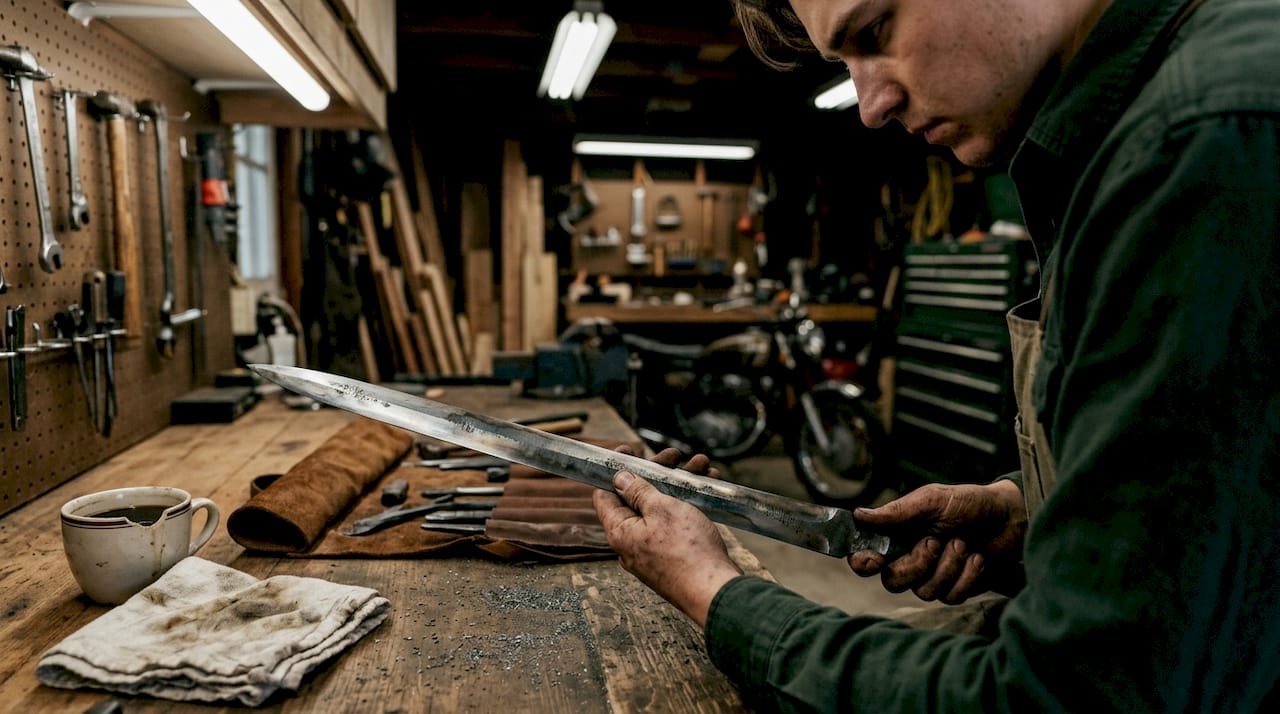
Provenance and authenticity add long-term value. Replicas of famous historical swords, certified limited editions, and pieces from known makers all carry provenance that pure decorative swords lack. Understanding the reasons for sword collecting helps clarify whether provenance matters more to you than aesthetics. For some collectors, owning a faithful replica of a historically documented blade outweighs owning a beautiful but fictional design.
Here are the core evaluation criteria to include on every checklist entry:
- Steel type and grade: Damascus, high-carbon, stainless, or spring steel
- Construction method: Hand-forged, stock removal, or machine stamped
- Handle (hilt) materials: Wood, bone, leather wrap, or synthetic
- Blade finish: Polished, hand-rubbed, etched, or acid-treated pattern
- Scabbard and fittings: Leather, wood core, metal throat and chape
- Historical accuracy or licensed authenticity: Period correct or officially licensed
- Condition and care requirements: Maintenance demands and storage needs
Pro Tip: Before adding any sword to your list, physically handle it if possible, or request detailed close-up photos of the guard, pommel, and blade edge. These areas reveal the most about overall quality.
Top collectible sword categories and must-have picks
Armed with solid evaluation criteria, let's explore the major categories and stand-out swords that collectors genuinely should not miss. Each category serves different collecting goals, so knowing which resonates with you shapes a more focused and satisfying collection.
Top collectible sword categories:
-
Medieval and European knightly swords: The backbone of most serious collections, these blades cover arming swords, longswords, bastard swords, and the great swords used across European history from roughly 500 to 1600 CE. The medieval sword selection at TopSwords covers authentic silhouettes with historically proportioned blades, crossguards, and pommels that display beautifully on any wall or stand.
-
Custom Damascus steel swords: Nothing commands attention in a collection like the flowing water patterns of a hand-forged Damascus blade. A custom Damascus sword combines functional craftsmanship with visual drama, making it an anchor piece for almost any serious display.
-
Middle Eastern and curved blade swords: Scimitars, kilij, shamshir, and tulwar blades represent some of the most elegant sword designs in history. The curved geometry creates an instantly recognizable profile. Quality scimitar sword options in hand-forged Damascus steel bring genuine regional history to your shelf.
-
Fantasy and movie replicas: Pop culture has driven explosive interest in iconic fictional blades. From elven daggers to legendary movie weapons, these pieces attract collectors who connect collecting with fandom. Fantasy and movie replicas done well feature accurate proportions, screen-matched finishes, and quality construction that stands up alongside historical pieces.
-
Viking and Celtic swords: These regional designs carry distinct visual identities, including lobed pommels, wide fullers, and pattern-welded blade patterns that reflect the actual techniques Norse and Celtic smiths used. They appeal strongly to collectors with an interest in Northern European history.
-
Anime and themed blades: Oversized, geometrically bold, and often brightly finished, anime-inspired swords attract a dedicated collector base. Their distinctive forms add visual contrast to mixed collections and serve double duty for cosplay use.
Here is a quick comparison of major categories to guide your checklist building:
| Category | Historical basis | Display impact | Typical materials | Best for |
|---|---|---|---|---|
| Medieval European | High | Classic, imposing | Carbon steel, leather | History-focused collectors |
| Custom Damascus | Variable | Very high | Layered Damascus steel | Statement pieces |
| Scimitar and curved | High | Elegant | Damascus, stainless | Regional history fans |
| Fantasy replicas | Low to none | Very high | Stainless, alloy | Fandom and movie fans |
| Viking and Celtic | High | Rustic, bold | Carbon steel | Norse history enthusiasts |
| Anime and themed | None | Bold, colorful | Stainless, zinc alloy | Cosplay and themed collections |
Comparing top collectible swords: Features, pros, and cons
Once you know the categories, a direct comparison makes it much easier to decide which swords belong on your own checklist. This side-by-side view highlights the real trade-offs collectors face.
A double edge short sword in hand-forged Damascus with a leather sheath delivers maximum craftsmanship in a compact form. Short swords and daggers are genuinely underrated in collections because their smaller scale allows tighter display arrangements, while the craftsmanship per inch of blade is just as impressive as longer pieces.
The historical short sword for display takes a different angle, prioritizing historical accuracy and versatility. These pieces work equally well at Renaissance fairs, as display centerpieces, or as gifts for enthusiasts who are just starting out.
"The most memorable collections are not the largest ones. They are built from pieces chosen with intention, where every blade tells a story the collector can recite from memory."
Key comparison points to evaluate any sword against each other:
- Handmade vs. machine made: Hand-forged pieces show visible character and structural integrity; machine-made swords are consistent but lack personality
- Leather scabbard included: A quality scabbard adds display value and protects the blade; a missing or cheap scabbard is a red flag
- Historical accuracy: Period-correct proportions and fittings add authenticity that mass-produced swords skip
- Blade length and weight: Both affect display options and handling feel; longer blades need wall-mounted horizontal displays
- Care requirements: Damascus steel needs regular oiling to prevent oxidation; stainless steel is more forgiving for low-maintenance collectors
- Price to craftsmanship ratio: The most expensive piece is not always the best value; focus on construction quality relative to cost
Exploring the sword legends behind famous historical blades also helps collectors appreciate why certain design elements like fuller depth, crossguard width, and pommel weight are not random. These features reflect centuries of battlefield refinement, and understanding that context makes evaluating replicas far more meaningful.
Situational recommendations and overlooked gems
Beyond general comparison, matching swords to your specific collector profile makes the difference between a collection that feels cohesive and one that looks like a random assortment. Here is how to think about it based on where you are in your collecting journey.
Beginner collectors should start with versatile medieval or European sword designs. These offer strong historical grounding, wide stylistic appeal, and forgiving display requirements. A classic arming sword or a single-handed knightly sword gives you an anchor piece that looks appropriate in nearly any display context. Avoid jumping into highly specialized pieces before you understand what aesthetic directions genuinely excite you.
Seasoned collectors benefit most from rare or custom hand-forged pieces, regional blades outside mainstream categories, and historically documented replica designs. At this stage, uniqueness and craftsmanship matter more than broad appeal. Custom Damascus pieces with engraving options, limited-run reproductions, and blades from documented historical traditions all reward the deeper knowledge experienced collectors bring.
Thematic and cosplay-focused collectors should lean into fantasy, anime, and movie replica categories without apology. A themed collection built around a specific fictional universe, an era of cinema, or a gaming franchise is a completely valid and visually striking approach. The key is choosing replicas made with genuine attention to accuracy and build quality rather than cheap licensed products.
Here are overlooked gem categories that deserve more checklist attention:
- Regional daggers and short swords: Often higher craftsmanship per dollar than full-length swords, yet undervalued in most collections
- Scabbard-forward pieces: Swords with exceptionally detailed or historically accurate scabbards add a display dimension most collectors ignore
- Pattern-welded and twist-core blades: The visual complexity of twist-pattern Damascus rivals any decorative element a sword can have
- Knightly companion pieces: A matched dagger and sword set tells a richer historical story than individual pieces alone
- Non-European traditions: Persian, Indian, Japanese, and African blade traditions are massively underrepresented in most Western collections
Pro Tip: When you feel stuck on what to add next, consider swords for gifts as a framework. The same qualities that make a sword a great gift, including striking design, quality materials, and clear narrative, make it a great collectible.
The collector's mindset: Why the perfect checklist evolves
Every experienced collector eventually reaches the same realization: the checklist that made sense at the beginning of their journey looks almost nothing like the one they use five years in. And that is exactly how it should work.
A checklist built on rigid rules creates a collection that stops growing. The collector who decides on day one that they will only acquire European longswords and nothing else will eventually feel trapped by their own rules. Taste deepens. Knowledge expands. Unexpected pieces show up that break every category you thought defined you, and sometimes those are the most important acquisitions you ever make.
The most interesting collections we have seen operate from a different mindset: the checklist is a living document. Categories get added. Criteria get refined. Price thresholds adjust as the collector gains confidence in evaluating quality at a glance. What starts as a beginner-friendly list of basics eventually becomes a nuanced personal manifesto reflecting years of learning, handling, and choosing.
The practical implication of this mindset is that you should revisit your evaluation criteria at least once a year. Ask yourself whether the materials you prioritize still reflect your current aesthetic preferences. Whether the categories you focus on still excite you. Whether there are historical traditions or fictional universes you have been curious about but dismissed too quickly. Referencing your approach to building a sword collection regularly keeps your process intentional rather than reactive.
The collectors whose displays genuinely impress are not the ones who followed the strictest rules. They are the ones who stayed curious, kept refining their standards, and were willing to change direction when a piece spoke to them in a way their checklist had not anticipated. Flexibility, grounded in solid evaluation criteria, is what separates a great collection from a merely large one.
Build your collection with confidence
Ready to move from planning to acquiring? Your checklist is only as good as the sources you use to find quality pieces.
At TopSwords, the entire catalog is built around the criteria serious collectors care about most: hand-forged construction, authentic materials like Damascus and high-carbon steel, and detailed finishing that holds up to close inspection. Whether you are adding a statement custom handmade sword to anchor your display or systematically working through categories and want to browse medieval swords to find your next piece, the selection covers every collector profile from beginner to seasoned enthusiast. Every blade is described with the detail you need to evaluate it against your own checklist before it arrives at your door.
Frequently asked questions
What makes a sword collectible versus decorative?
Collectible swords feature high-quality materials, historical significance, genuine craftsmanship, and limited availability, while decorative swords prioritize visual appearance over authenticity or build integrity.
Should I focus on replicas or original antiques when starting a collection?
Replicas are ideal for beginners because of their affordability and accessibility, while antiques suit experienced collectors who prioritize rarity, provenance, and documented historical origins.
How can I verify the authenticity of a handcrafted sword?
Choose reputable sellers, request provenance documentation, and closely examine material details including Damascus patterning, steel markings, and hand-finished fittings that machine production cannot replicate.
What's the best way to safely store and display collectible swords?
Use secure wall mounts or purpose-built stands, keep blades away from humidity and direct sunlight, oil Damascus steel regularly, and inspect scabbard fittings periodically to catch any loosening before damage occurs.
Are movie and anime swords valuable to serious collectors?
Absolutely. Well-crafted, limited edition fantasy and movie replicas carry growing collector value and display appeal that stands alongside traditional historical pieces in any serious collection.