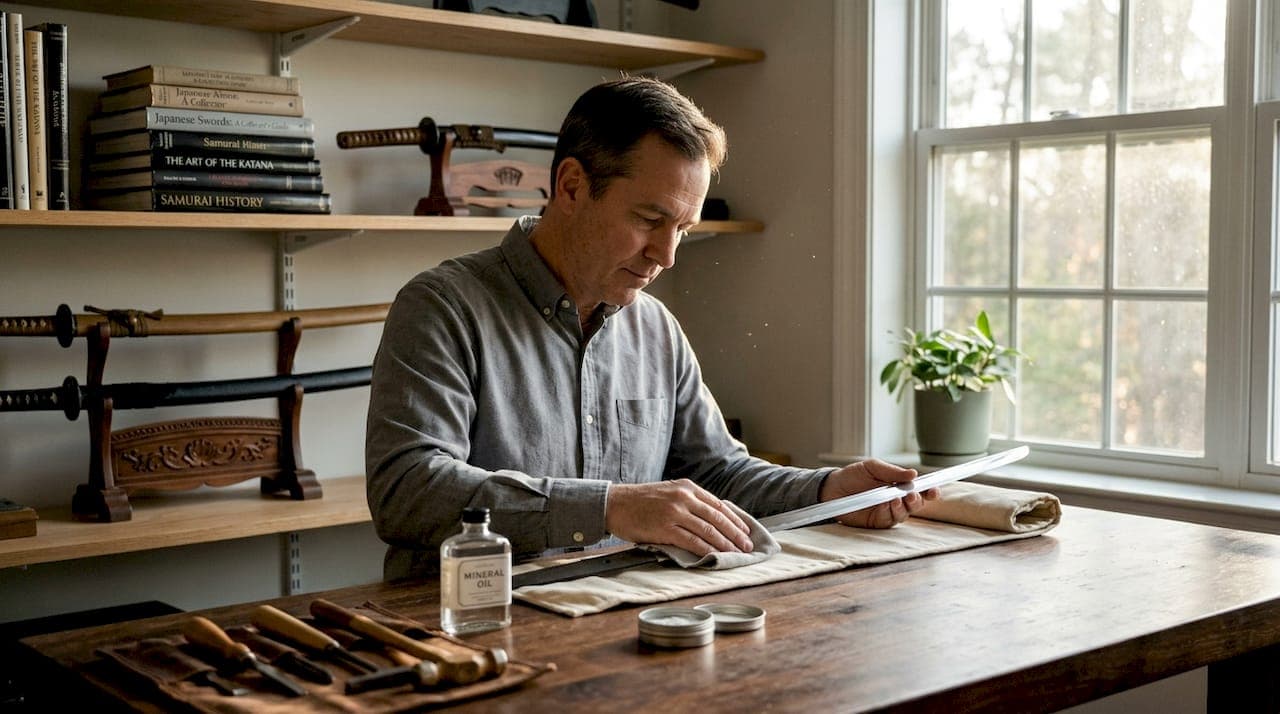
Oiling your blade once a month and calling it done is a widespread habit among newer collectors, but it barely scratches the surface of what a sword truly needs to stay in peak condition. Sword maintenance is a disciplined practice that combines cleaning, inspection, rust prevention, safe storage, and knowing exactly when to put down the cloth and call in an expert. Whether you own a modern Damascus steel piece or a centuries-old antique, your approach to care will directly affect its sharpness, safety, and long-term value. This guide covers everything from the fundamentals to the advanced decisions that separate casual owners from serious collectors.
Table of Contents
- Understanding sword maintenance: Beyond the basics
- Step-by-step: Essential sword maintenance tasks
- Pitfalls and mistakes: What most collectors get wrong
- Advanced care: When and why to seek professional restoration
- Why collectors should treat maintenance as an art, not a chore
- Ready to elevate your collection? Explore premium swords and care kits
- Frequently asked questions
Key Takeaways
| Point | Details |
|---|---|
| Routine attention | Sword maintenance requires regular cleaning, oiling, and inspection for lasting performance. |
| Gentle rust removal | Address light rust with oil or soft tools; avoid harsh abrasives, especially on antiques. |
| Know your limits | Seek professional help for polishing or heavy corrosion to protect your investment. |
| Preserve, don’t just clean | Proper methods maintain value and beauty, making your sword a true collector’s piece. |
| Respect history | Expert restoration preserves both the function and the story behind each blade. |
Understanding sword maintenance: Beyond the basics
To understand what sword maintenance truly involves, let's start by dispelling the common "oil and forget" myth. Real maintenance is a multilayered system, not a single action. It includes routine cleaning, surface inspection, corrosion prevention, proper oiling, and, at certain thresholds, professional restoration. Each element serves a specific purpose, and skipping any one of them creates vulnerabilities in the long-term condition of your blade.
The goals of a solid maintenance routine are straightforward but interconnected:
- Preserving sharpness so the blade performs as intended
- Preventing rust and corrosion that degrade the steel over time
- Maintaining aesthetics including finish, polish, and visual detail
- Ensuring safety during handling, display, and transport
- Protecting monetary and historical value for display pieces and antiques
One of the most important distinctions in maintenance is the difference between modern production swords and antique or historical pieces. Modern high-carbon steel blades tolerate slightly more aggressive cleaning methods. Antiques are a different story entirely. Their steel has often developed a natural patina over decades or centuries, and that patina is part of what makes them valuable and historically authentic. Before starting any identifying quality swords process, knowing exactly what you have is non-negotiable.
"Treat a sword like it is worth more than you paid for it, because years of proper care will make that literally true."
For rust specifically, the approach must match the severity and the blade type. For light surface rust, an oil soak, fine emery cloth, or a dedicated rust eraser can resolve the issue without causing damage. However, using abrasives on antique blades risks stripping away finishes and historical character. For heavy rust or full polishing jobs, a professional togishi (a Japanese sword polisher) is not an optional choice; it is the only responsible one.
Step-by-step: Essential sword maintenance tasks
With the wider picture clear, let's break down the actual process collectors should follow. A consistent routine removes guesswork and protects your investment over years and decades.
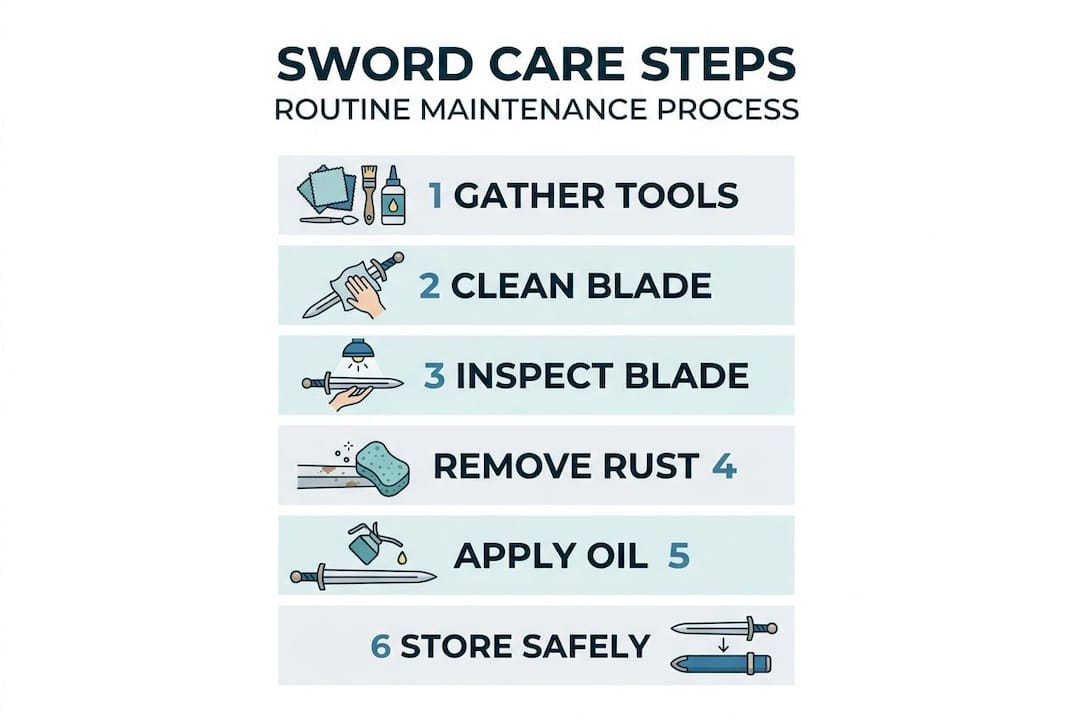
Step 1: Gather your tools You need lint-free microfiber cloths, a dedicated sword oil (mineral-based, acid-free), a soft wooden mekugi punch if working on Japanese swords, and optionally a rust eraser for minor spots. Avoid paper towels as they leave micro-scratches on polished surfaces.
Step 2: Initial cleaning Unsheathe the sword carefully and wipe the blade from spine to edge in long, smooth strokes using a dry cloth. This removes dust, fingerprints (which contain skin acids that accelerate rust), and any loose particles. Never wipe from the edge outward, as this risks cutting the cloth and your hand.
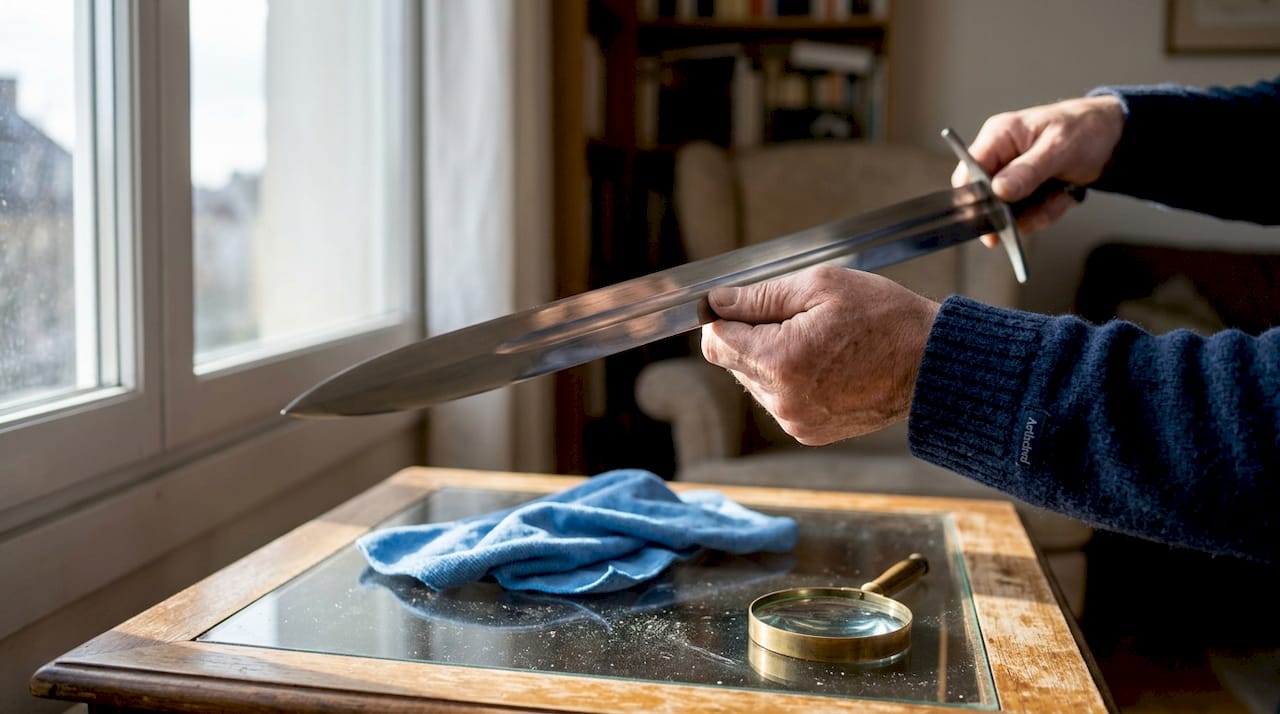
Step 3: Visual inspection Hold the blade at an angle under good natural or artificial lighting. You are looking for pitting, rust spots, micro-chips along the edge, and any irregularities in the surface finish. Catching problems early is dramatically cheaper and simpler than addressing advanced damage. Pay close attention to the area near the habaki (the blade collar on Japanese swords) where moisture tends to collect.
Step 4: Rust and stain removal For very light surface oxidation, apply a drop of sword oil to the affected area and let it soak for a few minutes. Use a rust eraser with gentle, circular motion on modern steel. For antique blades, stop at the oil soak stage and consult a professional if the rust does not lift easily. Never use steel wool or coarse sandpaper on any collector-grade sword.
Step 5: Oiling Apply two or three drops of mineral oil to a clean cloth and distribute it evenly across the entire blade surface from ricasso (the unsharpened section near the guard) to tip. The layer should be thin and uniform. Excess oil attracts dust and can seep into wooden sheaths, damaging the lacquer or lining over time.
Step 6: Reassembly and storage Reassemble any fittings carefully. Store the sword in a low-humidity environment (ideally between 45 and 55 percent relative humidity). Use a padded sword rack or sword bag made from non-acidic materials. Avoid storing horizontally for Japanese swords; edge-up vertical storage is traditional and helps prevent warping.
Maintenance comparison by blade type:
| Task | Modern steel sword | Antique/historical sword |
|---|---|---|
| Cleaning cloth | Microfiber, dry | Soft silk or microfiber only |
| Rust removal | Oil + rust eraser | Oil soak only; professional if persistent |
| Oiling frequency | Every 1 to 3 months | Every 1 to 2 months (climate-dependent) |
| Sharpening | DIY with correct tools | Professional togishi only |
| Polish | Home polish acceptable | Never DIY; expert required |
Understanding the science of blade sharpness helps you make better decisions during inspections, especially when deciding whether an edge needs professional attention. Similarly, knowing your blade's sword finish type (mirror, satin, or antique patina) tells you which products are safe to use.
Pro Tip: If you can see your reflection clearly in the blade after oiling, you have applied too much oil. A well-oiled blade should have a subtle sheen, not a mirror gloss from the oil itself.
Pitfalls and mistakes: What most collectors get wrong
Understanding core tasks is essential, but avoiding mistakes is equally crucial. Many collectors with years of experience still fall into habits that quietly damage their most prized pieces. Here are the most common offenders:
- Over-cleaning: Wiping the blade after every handling session with aggressive products strips the protective oil layer and introduces micro-abrasions. A quick visual check and a light wipe with a dry cloth is usually enough between scheduled maintenance sessions.
- Using cooking oil or WD-40: Both are common amateur substitutions. Cooking oil goes rancid and becomes acidic over time. WD-40 is a water displacer, not a long-term lubricant or protectant, and it leaves a residue that attracts grime.
- Aggressive sharpening without knowledge: Running a blade across a random whetstone changes the geometry of the edge. The angle of a sword's bevel is specific to its design and purpose. Altering it even slightly diminishes both performance and value.
- Skipping the sheath inspection: The inside of a wooden sheath can trap moisture, debris, or even small abrasive particles. A blade pulled through a contaminated sheath gets scratched every single time.
- Ignoring handle fittings: Loose handle fittings are a safety issue, not just an aesthetic one. A blade that shifts under force can injure the user and damage the sword simultaneously.
The nuance around Japanese swords deserves special attention. Professional togi polishing reveals the hamon (the temper line formed during heat treatment) and the jihada (the grain pattern of the folded steel) without altering the blade's geometry. DIY sharpening, even with good intentions, risks creating edge asymmetry known as ha-niku or ha-mise distortion. These are structural flaws that require extensive professional remediation to correct, and in some cases they cannot be fully reversed.
If you are new to the collector world, reviewing a thorough guide on buying collector-grade swords before your next purchase gives you a much clearer sense of what a well-made, properly finished blade should look like before you start any maintenance work. Equally important is understanding safe handling practices to protect both yourself and the sword during every maintenance session.
Pro Tip: Mark your calendar with quarterly maintenance reminders. Consistent, light-touch care is always better than infrequent deep-cleaning sessions that are more likely to cause accidental damage.
Advanced care: When and why to seek professional restoration
Some problems go beyond routine care, requiring skills and tools most collectors lack. Knowing the tipping point between DIY and professional work is one of the most valuable judgments you can develop as a collector.
Clear signals that it is time to call in a professional include:
Heavy or pitted rust: When rust has gone deeper than the surface, an oil soak and rust eraser will not reach it. Aggressive DIY attempts at this stage typically remove healthy steel along with the rust and create an uneven surface.
Chips or notches in the edge: A chipped edge requires grinding and resharpening. This is not a task for home tools, because the geometry of the edge must be maintained precisely. Even small errors compound over successive sharpening sessions.
Warping or bending: A warped blade requires a process called tsuchioki (clay application) and re-tempering. This is a forge-level skill and absolutely not a home repair.
Pre-sale or appraisal preparation: If you are preparing a sword for sale, auction, or formal appraisal, a professional polish delivers a result that home methods simply cannot match.
Comparison of DIY versus professional maintenance:
| Criteria | DIY maintenance | Professional restoration |
|---|---|---|
| Rust level addressed | Light surface only | Light to heavy, including pitting |
| Polish quality | Surface-level shine | Full geometry-preserving togi polish |
| Edge geometry preservation | Moderate risk | High precision |
| Hamon/jihada visibility | Not applicable | Fully revealed and enhanced |
| Cost | Low (tools only) | Moderate to high, depending on blade |
| Suitable for antiques | Cleaning only | Yes, with correct specialist |
The professional togishi process is a multi-stage art form that uses a series of progressively finer polishing stones to bring out the full beauty of the steel. Each stage is designed to refine specific elements of the surface without disturbing the blade's hardness profile or edge geometry. Most serious collectors with high-end pieces invest in professional servicing every few years, particularly for Japanese katanas and antiques.
If you own or are considering a high-quality Japanese katana, building a relationship with a trusted togishi before you ever need one is a smart collector's move. Waiting until damage occurs means working with a restorer under pressure, which is rarely ideal. A comprehensive collectible swords checklist can help you prioritize which pieces in your collection warrant the most careful professional attention.
Why collectors should treat maintenance as an art, not a chore
After breaking down the nuts and bolts of maintenance, it is worth reflecting on what is truly at stake. Maintenance is not just preservation. It is a form of active respect for the craft, the history, and the materials that went into making a blade.
Here is an opinion that not every guide will state plainly: collectors who treat maintenance as a chore almost always end up regretting it. Not immediately, but gradually. A sword that is oiled halfheartedly, stored in the wrong environment, and never properly inspected accumulates invisible damage across years. By the time it becomes visible, the cost in both money and irreversible loss of character is significant.
What changes the experience entirely is curiosity. When you learn what the hamon actually represents as a record of the heat treatment, or when you understand the science behind sharpness well enough to read an edge under light, maintenance becomes something you look forward to. It is the moment when you are closest to understanding what a blade actually is, beyond its surface appearance.
The most experienced collectors we have spoken to consistently describe the same shift: at some point, cleaning a sword stopped feeling like a task and started feeling like a conversation with a craftsman who may have lived hundreds of years ago. That is not a poetic exaggeration. A well-maintained sword carries forward the intent of its maker in ways that a neglected one simply cannot.
Know when to step back, too. One of the clearest marks of a genuinely skilled collector is the willingness to hand a blade to someone with more expertise. There is no weakness in that. It is judgment, and good judgment protects both the sword and your credibility as a custodian of something worth preserving.
Ready to elevate your collection? Explore premium swords and care kits
Put your expertise into practice with resources trusted by discerning collectors. Every technique covered in this guide starts with having a blade worth caring for.

At TopSwords, we offer a carefully curated selection of handcrafted blades built to reward proper maintenance with decades of beauty and performance. Browse our full medieval swords collection to find display-ready and functional pieces that meet collector-grade standards. If you want something truly unique, our custom Damascus battle sword with leather sheath is a masterclass in craftsmanship that showcases exactly why proper care matters. Every sword we carry is built to last, but only proper maintenance keeps it that way.
Frequently asked questions
How often should you maintain a sword?
Display swords should be inspected and lightly oiled every one to three months, while swords that are handled frequently should be checked after each use to catch rust before it develops.
What type of oil is best for sword maintenance?
High-quality, acid-free mineral oil is the most reliable choice because it protects against rust without leaving a reactive residue; specialized sword oils formulated for high-carbon steel are even better for long-term blade health.
Can you remove rust from antique swords at home?
Very light surface rust on antiques can be carefully addressed at home using an oil soak and a soft cloth, but anything more serious requires a professional because abrasives on antiques risk stripping historically significant patina and finishes.
Why is professional polishing important for Japanese swords?
The traditional togi polishing process reveals the hamon temper line and the jihada grain pattern while preserving the blade's precise geometry, whereas DIY sharpening risks permanent edge asymmetry that diminishes both function and collector value.