Sharper is better. It sounds obvious, almost self-evident, like something every sword collector just knows. But spend enough time around high-quality blades and you'll quickly realize that belief leads people astray more often than not. True blade sharpness isn't a single number on a scale or the ability to shave hair off your arm. It's a combination of geometry, steel properties, intended use, and historical context that most guides barely touch. Whether you're acquiring your first katana or adding a Damascus battle sword to a serious collection, understanding what sharpness actually means will change how you evaluate, maintain, and appreciate every blade you own.
Table of Contents
- Defining blade sharpness: Anatomy and fundamentals
- How geometry shapes sharpness: Swords through history
- Measuring sharpness: Science and tradition
- Sharpness versus durability: The edge case dilemma
- A sword collector's perspective: Beyond the numbers
- Enhance your collection with swords crafted for optimal sharpness
- Frequently asked questions
Key Takeaways
| Point | Details |
|---|---|
| Sharpness is multifaceted | True blade sharpness depends on edge geometry, apex condition, and thickness behind the edge, not just the initial edge grind. |
| Measurement blends science and tradition | Modern BESS and CATRA tests combine with historical practices like tameshigiri for a complete view of sword sharpness. |
| Balance beats extremes | A sword’s best edge is often a working sharpness—sharp enough to cut but robust for use and longevity. |
| Context determines ideal edge | Collectors and practitioners should consider a sword’s intended display or use when evaluating and maintaining sharpness. |
Defining blade sharpness: Anatomy and fundamentals
To start, let's break down exactly what blade sharpness is and isn't.
Most people picture sharpness as something that happens right at the very tip of an edge, like the thinnest possible line of metal. That's partially right, but only part of the picture. Blade sharpness is defined by two interacting factors: the refinement of the apex (the precise point where the two bevels of a blade meet) and the thickness of the steel just behind that apex, called behind-the-edge thickness or BTE. Both matter. An incredibly sharp apex on a blade with thick BTE still won't cut efficiently because the steel behind the edge wedges and binds as it pushes through material.
Think of it like a wedge being driven into wood. A very thin, acute wedge splits wood more easily than a fat, blunt one, even if the tip of each wedge is equally pointed. The same logic applies to what blade sharpness means for swords at every level of collecting.
Here's what a clean, functional sharp edge actually involves:
- A continuous apex with no visible rolls, nicks, or wire edges under magnification
- Minimal BTE so the blade enters material without excessive wedging resistance
- Consistent geometry along the full edge length, not just a single sweet spot
- Appropriate bevel angle matched to the sword's intended purpose (more on this below)
"Sharpness without the right geometry is like a fast engine in the wrong car. The potential is there, but it's not going to perform the way you expect."
Here's where many collectors make a costly mistake. They equate sharpness with durability or overall sword quality, when in reality, a sword that has been over-thinned or sharpened past its steel's capability is actually weaker at the edge. Pushing a blade to an extremely acute angle can remove too much supporting metal, making the apex fragile and prone to folding or chipping under any real stress. Improper sharpening that removes material unevenly also introduces micro-fractures and inconsistencies that weaken the edge structurally.
Pro Tip: When evaluating a sword's edge, run your thumb across (not along) the blade near the edge to feel for consistency. A well-sharpened sword will feel uniformly thin from heel to tip with no thick spots or dips. Thick spots usually mean inconsistent sharpening, while a gritty feel can indicate a rough apex that will dull quickly.
Sharpness is also just one element of a quality sword. The steel alloy, heat treatment, handle construction, and overall geometry all interact. A blade can have a sharp edge and still be a poor performer if those other factors are off.
How geometry shapes sharpness: Swords through history
Now that you know what creates sharpness, let's look at how sword design shapes it over centuries.
Blade geometry, including cross-section type, distal tapering, and profile tapering, directly determines how sharp a blade can realistically be and how it performs when cutting. Different eras and combat needs produced dramatically different geometries, each optimized for a specific kind of sharpness.
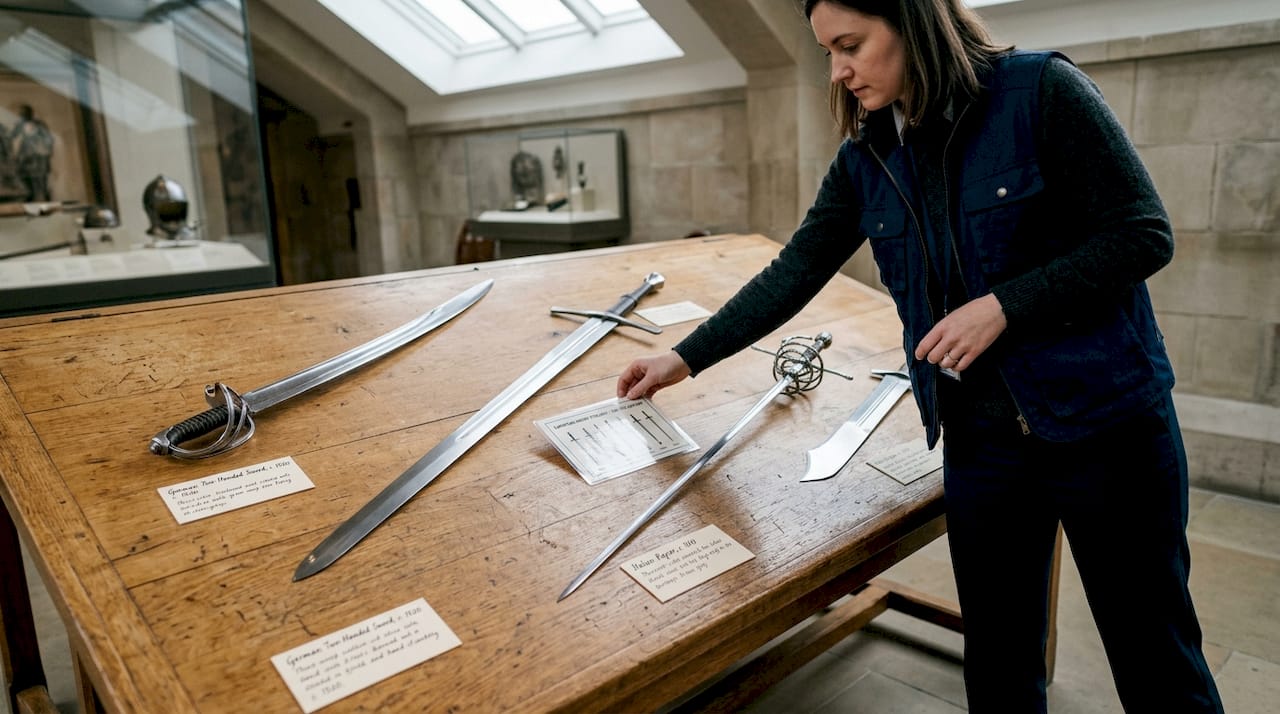
The two most common cross-sections in the evolution of medieval swords are lenticular and diamond profiles. A lenticular cross-section creates a lens-shaped blade that's thicker at the center and tapers smoothly to both edges. This geometry gives excellent cutting ability because there's less metal resisting the cut as the blade passes through. It was the dominant design for Migration-era and Viking-age swords built for slashing warfare.
The diamond cross-section, by contrast, has a central ridge (fuller) that stiffens the blade. This geometry works better for thrusting because the ridge adds rigidity and allows distal tapering toward the point without losing structural strength. Late medieval swords evolved toward this profile specifically to defeat increasingly heavy plate armor through gaps, requiring a stiffer, more pointed blade rather than a wide cutting edge.
| Sword type | Cross-section | Edge angle | Primary purpose |
|---|---|---|---|
| Viking sword | Lenticular | 20-25 degrees | Slashing, cutting |
| Arming sword | Lenticular/diamond | 20-30 degrees | Cutting and some thrusting |
| Estoc | Diamond | N/A (point only) | Pure thrusting |
| Katana | Convex (hamaguri) | 25-30 degrees | Draw-cutting, tameshigiri |
| Rapier | Diamond | 30-40 degrees | Thrusting, point control |
| Falchion | Single-bevel | 20-25 degrees | Heavy chopping |
Modern reproductions intended for display often sacrifice optimal geometry to reduce cost or improve visual aesthetics. A display sword might look historically accurate but have a thicker BTE and blunter apex than the original it replicates. That's not necessarily wrong, but collectors should know the difference. Katana sharpness benchmarks matter especially for Japanese-style blades, where the traditional convex grind (hamaguri-ba) creates a geometry that's both durable and extremely efficient at draw-cutting through soft targets.
Key points for collectors evaluating geometry:
- A thicker spine with appropriate distal taper means better balance and structural integrity
- Profile taper affects point-of-balance, which changes how the sword moves in use
- Wider blades with lenticular profiles tend to be better cutters but worse thrusters
- Modern high-carbon reproduction swords often match historical geometry more closely than decorative stainless steel pieces
Measuring sharpness: Science and tradition
But how do you actually quantify sharpness, both in the lab and in practice?
The answer lies in two very different worlds: modern materials science and centuries of empirical sword tradition. Both give useful data, and a serious collector benefits from understanding both.
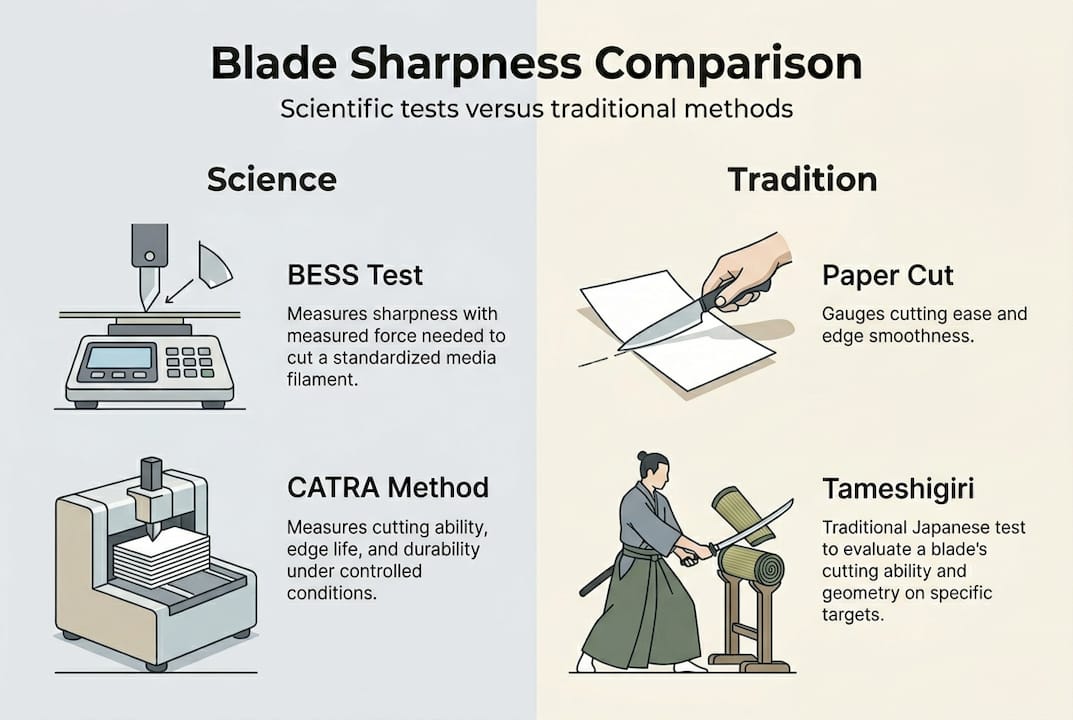
Scientific methods use standardized tests to assign numbers to sharpness. The two most relevant are BESS and CATRA. The BESS scale measures the grams of force required to sever a standardized monofilament; a lower score means a sharper edge. CATRA (Cutlery and Allied Trades Research Association) tests measure ICP (initial cutting performance) and TCC (total cutting capacity), where ICP reflects how well a blade cuts on the first pass and TCC shows how well it retains that sharpness over extended use.
Here's how common BESS benchmarks break down:
| BESS score | Sharpness classification | Typical use |
|---|---|---|
| Under 100 | Razor sharp | Surgical, shaving |
| 100-200 | Very sharp | Fine cutting tasks |
| 200-400 | Sharp working edge | General purpose, light tameshigiri |
| 400-600 | Moderate working edge | Heavy cutting, battle-ready swords |
| Over 600 | Dull | Needs sharpening |
Traditional empirical methods go back centuries. Tameshigiri, the Japanese practice of test-cutting rolled tatami mats or bamboo, gave swordsmiths and warriors practical feedback that no instrument could provide. A clean, single-stroke cut through multiple mats confirmed both edge quality and blade geometry. The Japanese wazamono ranking system graded swords based on tameshigiri performance, from saijo o-wazamono (the finest) down to lower grades, essentially creating an empirical sharpness and cutting efficiency rating system before modern science existed.
Here's how sharpness testing works today for functional swords:
- Visual inspection under magnification to identify apex continuity and BTE
- BESS testing using a standardized filament and a calibrated device to get a numeric score
- Paper cutting test as a quick field check (cutting printer paper cleanly in a controlled stroke)
- Tameshigiri on traditional rankings with wet tatami mats for functional blades
- Post-cut inspection to check if the edge held, rolled, or chipped under real-world stress
Premium production swords from reputable makers typically score 150 to 300 BESS, while budget decorative pieces often register above 800 BESS and wouldn't pass a basic paper cut test without effort. That gap explains the price difference between a wall-hanger and a working blade far more concisely than any catalog description.
Sharpness versus durability: The edge case dilemma
With all that, is sharper always better? Not when durability and real sword use are concerned.
This is where the conversation gets genuinely interesting, and where many collectors get burned, sometimes literally. Razor-sharp edges under 150 BESS are fragile by design. The apex is so fine that it has very little supporting metal behind it. Under impact, torsional stress, or contact with anything rigid, that ultra-fine edge will roll, chip, or fold. A working edge in the 300 to 600 BESS range, by contrast, has enough material behind the apex to resist deformation while still cutting effectively through soft targets like tatami or bamboo.
Historical swords almost never had razor-sharp edges in the modern sense. A typical medieval arming sword was kept at a functional cutting edge that would hold up through repeated strikes against metal, leather, and bone. Over-sharpening would have been counterproductive and potentially dangerous to the user if the edge rolled unexpectedly during a cut.
Here's a practical guide for matching edge type to use:
- Display only: Any sharpness level is fine; edge retention is irrelevant; protect with oil
- Light tameshigiri: 200-400 BESS working edge with consistent geometry across the full length
- Heavy cutting practice: 400-600 BESS with a slightly thicker BTE for durability
- Cosplay handling: Blunted or rolled edge for safety; no cutting performance needed
- Collector's functional piece: 200-350 BESS balanced with appropriate steel hardness (57-60 HRC for most sword steels)
Here's what over-sharpening actually looks like in practice. A katana taken to a 10-degree apex on each side (20 degrees total) will feel terrifyingly sharp on paper. But strike that blade against wet bamboo at the wrong angle, and you'll see edge deformation that takes serious work to correct. A 25-degree total apex on a properly heat-treated blade will survive that same cut and dozens more.
Pro Tip: When choosing a sword for cutting practice, look for the steel's Rockwell hardness specification alongside the sharpness details. A blade at 58-60 HRC can hold a keener edge with better durability than a soft 50 HRC blade that rolls easily. The steel and the razor-sharp vs. working edges conversation are always linked.
"The ideal sword edge for real use isn't the sharpest possible. It's the sharpest the steel and geometry can sustain under actual cutting conditions."
A sword collector's perspective: Beyond the numbers
Stepping back, here's why sharpness is more nuanced for collectors than most realize.
In our experience watching collectors chase sharpness, the biggest mistake isn't choosing the wrong BESS score. It's assuming the number is the whole story. A historically accurate reproduction of a 13th-century knightly sword shouldn't necessarily hit a 150 BESS razor edge. That's not what those blades were designed for. Chasing modern sharpness metrics on a historical replica can actually destroy the geometry that makes the sword authentic in the first place.
What experienced collectors learn to appreciate is appropriate sharpness: an edge profile that matches the sword's intended role, period, and construction. A Viking-age lenticular blade with a 25-degree edge is historically honest and functionally capable. Grinding that same blade to a 15-degree razor edge to impress at the next club meeting makes it a worse sword by every meaningful measure.
The most revealing tests aren't BESS scores, they're tameshigiri results, where a properly geometried sword with a working edge often outcuts an over-sharpened blade because it doesn't deform under stress. The science and tradition tell the same story once you know how to read both.
Collectors who explore sword craftsmanship secrets quickly realize that the best makers don't talk about making blades "as sharp as possible." They talk about making blades as sharp as appropriate, a distinction that separates genuine craft from marketing language.
Enhance your collection with swords crafted for optimal sharpness
If you're inspired to add a finely-sharpened sword to your collection, TopSwords offers carefully crafted options that balance edge geometry, steel quality, and historical accuracy.

Every piece in the TopSwords lineup reflects an understanding that sharpness serves purpose. Whether you're drawn to the refined geometry of a custom Damascus battle sword with its layered steel performance or the historically grounded profiles found in the shop medieval swords collection, each blade is built with the right edge for its role. From display-ready pieces with protective finishes to functional cutting swords with working edges, you'll find blades matched to your intent. Browse all swords to explore the full range and find your next centerpiece.
Frequently asked questions
How is sword blade sharpness tested today?
Modern sharpness is tested using BESS and CATRA to measure edge force and cutting retention, while traditional tameshigiri uses practical mat and bamboo cutting to validate real-world performance.
What is a working edge versus a razor edge on a sword?
A working edge at 300 to 600 BESS offers durability for actual cutting tasks, while a razor-sharp edge below 150 BESS is extremely sharp but fragile and prone to rolling or chipping under impact.
Does sharper always mean better for sword collectors?
Not always. An ultra-sharp edge may sacrifice durability and historical authenticity, since swords historically were kept at functional working edges rather than razor sharpness to withstand real combat conditions.
What sword edge is best for tameshigiri?
A robust but sharp working edge in the 200 to 400 BESS range is ideal for tameshigiri because it makes clean cuts through wet tatami without the fragility that comes with an ultra-fine razor edge.