Most people assume a good sword just "feels right" the moment you hold it. That instinct is not wrong, but it is incomplete. Sword balance is measurable, technical, and directly tied to how well a blade performs, how historically accurate it is, and how much a collector should be willing to pay for it. Whether you are building a display collection, suiting up for cosplay, or training in historical European martial arts (HEMA), understanding balance puts you miles ahead of buyers who shop by looks alone. This guide breaks it all down in plain language so you can evaluate any blade with confidence.
Table of Contents
- Defining sword balance: What it means and why it matters
- Types of sword balance: Exploring the spectrum
- How balance affects handling, performance, and collecting value
- Evaluating sword balance: Practical tips for buyers and enthusiasts
- Why sword balance is more nuanced than most guides suggest
- Shop expertly balanced swords and knives at Top Swords
- Frequently asked questions
Key Takeaways
| Point | Details |
|---|---|
| Sword balance basics | Balance refers to weight distribution, affecting how a sword feels and performs. |
| Types of balance | Blade-heavy, handle-heavy, and neutral—each offers unique handling and purpose. |
| Practical evaluation | Simple point of balance tests help buyers assess swords hands-on or online. |
| Nuanced selection | Optimal balance depends on your intended use, style, and personal preference. |
Defining sword balance: What it means and why it matters
Sword balance describes how weight is distributed along the full length of a blade, from the tip of the pommel to the tip of the point. It is not simply about how heavy a sword feels. Two swords with identical weight can feel completely different in the hand because their mass sits in different places.
The most important measurement here is the point of balance (POB), sometimes called the center of mass. This is the spot along the blade's length where the sword would rest perfectly level on a single finger. On most functional swords, this sits somewhere between two and six inches forward of the guard (the crosspiece separating blade from handle).
Several concepts matter when thinking about balance:
- Translation: The sword moves in a straight line, like a thrust. Mass located near the hilt makes this movement more efficient.
- Rotation: The sword swings in an arc. For powerful rotational cuts, the mass benefits from being placed further forward, or counterweighted through pommel and guard placement.
- Pommel counterweight: A heavier pommel pulls the POB back toward the hand, improving tip control.
- Guard placement: A heavy guard shifts mass toward the hilt, while a minimal guard allows more blade mass to dominate.
"Balance optimizes translation (mass near hilt) vs rotation (counterweight placement: pommel vs guard); longer blades favor rotational balance."
Different purposes reward different styles of balance. A display sword can prioritize aesthetics over optimized POB. A cosplay sword needs to look accurate without fatiguing the wielder through long convention hours. A martial arts training sword demands precise, repeatable handling. Always start your evaluation by identifying your intended use, and check out safe sword handling tips before you begin practicing with any blade.
Types of sword balance: Exploring the spectrum
Now that we understand the basics, how does sword balance actually vary between sword types, both historical and modern?
Sword balance generally falls into three broad categories: blade-heavy, handle-heavy, and neutral. Each has distinct physical markers and practical strengths.
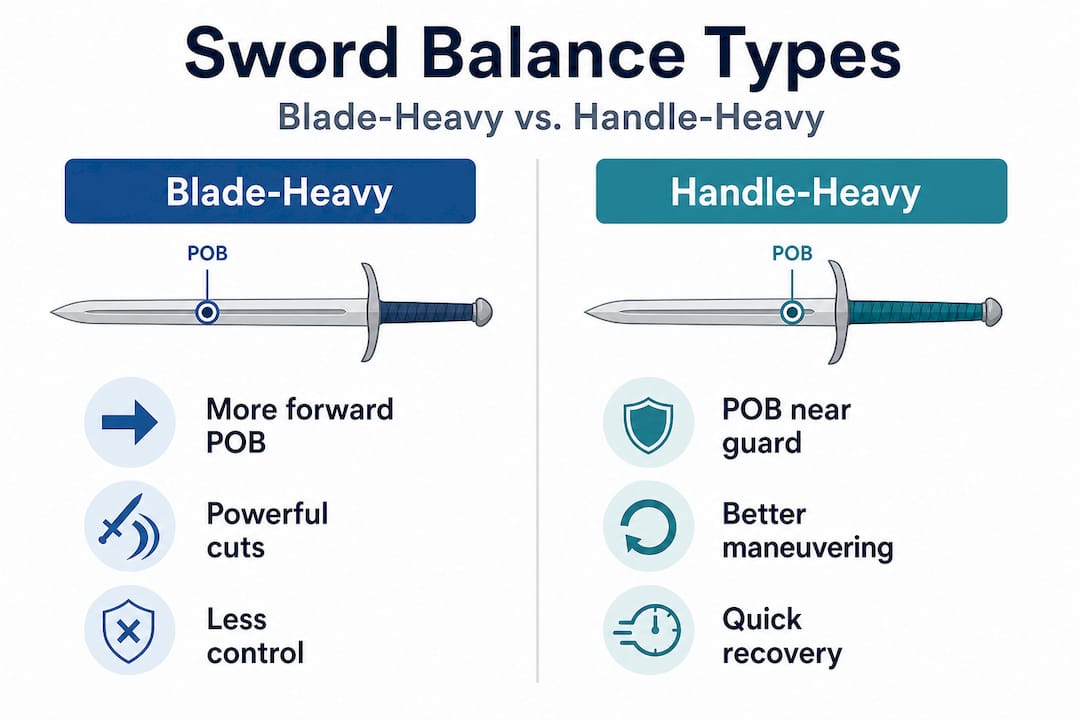
Blade-heavy balance places the POB more than four or five inches forward of the guard. This design puts more mass into the swing, generating greater force on impact. Choppers and heavy cutting swords often fall here.
Handle-heavy balance pulls the POB within one or two inches of the guard, or even behind it. The sword almost wants to "fall back" into your hand, making it fast to redirect and easy to maintain precise tip placement.
Neutral balance sits in the middle, roughly two to four inches forward of the guard. Most well-crafted functional swords land here, offering a blend of cutting force and control.

| Sword type | Typical POB (from guard) | Balance style | Best use case |
|---|---|---|---|
| Katana | 3 to 5 inches | Neutral to blade-heavy | Cutting, martial arts |
| European longsword | 3 to 4 inches | Neutral | Versatile combat, HEMA |
| Rapier | 1 to 3 inches | Handle-heavy | Thrusting, fencing |
| Falchion | 4 to 6 inches | Blade-heavy | Chopping, battlefield use |
| Arming sword | 2 to 4 inches | Neutral | All-purpose historical use |
| Cosplay replica | Varies widely | Often blade-heavy | Display, convention wear |
Balance can also be intentionally adjusted by a skilled swordsmith. A longer pommel adds counterweight. A thinner blade profile reduces forward mass. A heavier guard shifts balance toward the hand. When you are identifying quality swords, look for evidence that these components were designed together rather than assembled as afterthoughts. A pommel that looks decorative but has no counterweight function is a clear sign of a wall hanger rather than a crafted weapon.
Blade geometry also plays a critical role. A blade that tapers aggressively toward the tip loses mass at the front, naturally pulling the POB back. A blade with a wide, thick profile near the tip will have a noticeably more forward balance, even if the overall weight is modest.
How balance affects handling, performance, and collecting value
Understanding types is vital, but how does balance truly impact the experience of wielding or owning a sword?
Balance has real, measurable effects on how a sword behaves in motion. Here is how it plays out in practice:
- Swing speed: A handle-heavy sword accelerates through cuts faster because less rotational inertia resists the swing. Think of the physics of a short lever versus a long one.
- Tip control: When the POB sits close to the hand, the tip responds to small wrist movements instantly. This matters enormously for thrusting swords like the rapier.
- Cutting power: A blade-heavy sword delivers more force on impact, which is why heavy chopping swords like the falchion were deliberately built this way for use against armored opponents.
- Fatigue and injury risk: A sword that is too blade-heavy causes the wielder to fight the weapon constantly, straining wrists and forearms. For reenactors and martial artists training over extended periods, this is a real injury risk.
- Precision in sparring: Neutral balance gives a fencer the best mix of speed and power, which is why tournament-grade longswords almost always land in that range.
Pro Tip: When comparing two swords of similar weight, always check where the POB falls before deciding which feels better. A sword that balances near the hilt will almost always feel lighter and more nimble in the hand, even if the scale says otherwise. Weight alone is one of the most misleading specs on a sword's product page.
For collectors, balance signals craftsmanship. A historically accurate medieval reproduction should match the known POB range for that sword type. If a maker claims their arming sword is a faithful replica but the POB sits six inches forward of the guard, something went wrong in production, probably a shortcut in the pommel or guard.
| Balance style | Usability | Historical realism | Cosplay comfort | Auction/collector value |
|---|---|---|---|---|
| Neutral | Excellent | High | Good | High |
| Handle-heavy | Very good | High (rapier, smallsword) | Excellent | High |
| Blade-heavy | Good for cutting | Moderate | Fair | Moderate |
| Extreme blade-heavy | Poor for extended use | Low | Poor | Low |
The medieval sword buying guide covers what specific historical swords should weigh and where their balance should land, which is essential reading if you are collecting period reproductions rather than fantasy replicas.
Evaluating sword balance: Practical tips for buyers and enthusiasts
With the impact of balance made clear, here is how you can confidently evaluate sword balance yourself, whether you are shopping online or handling swords in person.
In-person evaluation steps:
- Hold the sword loosely at the grip with one hand and find the spot on the blade where it rests balanced on your extended finger. Mark this mentally or note the measurement from the guard.
- Compare the POB to published specs for that sword type. If no specs exist, cross-reference against historical examples.
- Perform a slow-motion swing. The sword should feel like it follows your wrist rather than dragging it. Any sensation of the tip "pulling" or "falling forward" without your input suggests a too-far-forward POB.
- Try a simple thrust. The sword should track straight without wobbling. Excessive tip wobble often points to an unbalanced blade or inconsistent steel thickness.
- Hold the sword at full extension for thirty seconds. If the wrist or forearm fatigues quickly, the balance is likely too forward for practical use.
Evaluating balance from product descriptions online:
- Look for a published POB measurement in the product specs. Reputable makers list this alongside overall length, blade length, and weight.
- Calculate the POB as a percentage of blade length. For most functional swords, this should fall between 15% and 30% of the blade's length from the guard.
- Read hands-on reviews rather than relying solely on manufacturer copy. Reviewers who handle the actual piece will mention whether it "swings heavy" or feels agile.
- Check the pommel and guard materials. Steel components contribute meaningfully to balance. Decorative pommels made from lightweight alloys often skip the counterweight function entirely.
Pro Tip: At conventions, if you have the chance to handle a cosplay sword before purchasing, slowly rotate your wrist while the sword is at full extension. A well-balanced cosplay blade will stay roughly horizontal with minimal effort. One that drops quickly toward the tip is blade-heavy enough to cause noticeable fatigue by mid-afternoon. Pair this test with proper sword maintenance knowledge so your blade stays in top condition once you bring it home.
Warning signs to watch for include a POB sitting more than seven inches forward of the guard on any sword under 36 inches, a handle that feels hollow or rattles (compromising counterweight), and blades that flex noticeably near the hilt, which can indicate uneven steel thickness and inconsistent mass distribution.
Why sword balance is more nuanced than most guides suggest
Even with practical tips in hand, the story of sword balance is rarely as simple as guides make it sound.
The collector community tends to treat "neutral balance" as the gold standard for all swords, as if any deviation means the maker cut corners. That is a real oversimplification. Some of history's most effective weapons were deliberately imbalanced by modern standards, and for very good reasons.
Consider the executioner's sword. These wide, heavy blades were intentionally blade-heavy because their job was a single powerful downward strike, not sustained combat. Judging one against the neutral balance standard misses the point entirely. Similarly, certain historical messer and falchion designs show POBs that would horrify HEMA practitioners used to longswords, but those same designs cut through material in tests that neutral-balanced swords cannot match.
There is also the question of personal body mechanics. A taller swordsman with long arms may find a slightly more forward balance perfectly comfortable because the lever length between their wrist and the POB is naturally shorter. A shorter person holding the same sword might find it exhausting. Published balance specs describe the object, not the relationship between the object and the person using it.
The legends surrounding famous historical swords often skip this nuance entirely. When we call a sword like the Wallace Sword impressive, we are mixing myth, national identity, and historical function into a single story. Its balance, by the way, would be considered awkward by modern standards.
Collectors also often overweight balance relative to other quality indicators. Steel type, heat treatment, edge geometry, handle construction, and historical accuracy of fittings all matter enormously. A sword with a textbook POB but a poorly tempered blade is still a bad sword. The contrasting expert views on balance optimization remind us that even specialists disagree on what ideal balance looks like, because the answer genuinely depends on context.
Our honest advice: use balance as one data point in a broader evaluation, not a single pass-or-fail test. Whenever possible, handle the actual sword or find reviews from people who have. Specs on a page can tell you a lot, but they cannot fully replace the feedback you get from thirty seconds of holding the real thing.
Shop expertly balanced swords and knives at Top Swords
Ready to experience authentic sword balance for yourself? Explore these curated recommendations.
At TopSwords, every blade in the catalog is selected with craftsmanship and authentic handling in mind. You are not browsing generic wall hangers. You are looking at pieces where the pommel actually counterweights the blade, where the guard contributes to the overall balance equation, and where the specs reflect real design decisions.

Whether you are after a display-worthy Damascus steel piece, a cosplay sword built for long convention days, or a functional replica that holds up to real handling, the details matter. The custom handmade Damascus steel battle sword is a strong example: hand-forged construction with a genuine leather sheath, and balance considerations baked into the design from the start. Browse the full selection and filter by use case to find a blade matched to exactly what you need.
Frequently asked questions
How do you find the balance point on a sword?
Lay the sword horizontally and slowly move your finger along the flat of the blade until you find the spot where it rests level without tipping either direction. That spot is the point of balance, and on most functional swords it sits two to six inches forward of the guard.
Is a sword better if the balance is closer to the hilt?
Not always. Mass near the hilt improves control and reduces fatigue, but some sword types benefit from a more forward balance depending on their historical role and intended use, since longer blades favor rotation and can require more forward mass to perform correctly.
Can sword balance affect authenticity and value for collectors?
Yes, balance is a meaningful indicator of authenticity because historically accurate replicas should match the known POB range for their sword type. A piece that deviates significantly from the historical spec often signals production shortcuts, which affects both collector value and long-term desirability.
What is the main difference between blade-heavy and handle-heavy swords?
Blade-heavy swords place more mass toward the tip, excelling at chopping and powerful slashing cuts, while handle-heavy designs keep the POB near the hilt, giving the wielder faster tip control, better precision, and less fatigue during extended use.