
Many swords labeled "authentic" have been sold based on nothing more than a convincing patina, a stylistically correct hilt, and a dealer's handshake. That used to be enough. It isn't anymore. Advances in materials science now expose manufacturing secrets that are completely invisible to the naked eye, and collectors who rely on visual inspection alone are taking on real risk. Whether you're acquiring a centuries-old blade for historical study or investing in a premium handcrafted piece, understanding how authenticity is actually proven separates serious collectors from casual buyers.
Table of Contents
- Understanding sword authenticity: What it really means
- Modern techniques for assessing authenticity
- Visual inspection versus scientific validation
- Actionable steps for collectors: Authenticity in practice
- Why most collectors overlook scientific proof—and why it matters
- Top Swords: Trusted sources for authentic craftsmanship
- Frequently asked questions
Key Takeaways
| Point | Details |
|---|---|
| Scientific analysis is essential | Material testing gives collectors proof beyond visual inspection for sword authenticity. |
| Non-destructive methods preserve value | Modern tests can confirm authenticity without damaging precious swords and knives. |
| Combine tradition and science | Using both visual checks and scientific validation leads to best collector outcomes. |
| Request documentation | Always ask for provenance paperwork and scientific reports when purchasing. |
Understanding sword authenticity: What it really means
Authenticity in sword collecting is not a single quality. It's a layered concept that covers historical accuracy, geographic provenance, materials composition, and manufacturing method. A blade might look right and still be made from modern alloys. It might carry a convincing maker's mark and still have been forged in a country or era it doesn't claim.
The traditional approach leaned heavily on visual inspection: checking blade geometry, crossguard style, grip material, and surface patina. Experts developed sharp eyes, and that expertise genuinely mattered. But expert eyes can be fooled. Skilled forgers study the same historical references that collectors do. Artificial aging of metal is a real and refined craft. Visual cues are suggestive, not conclusive.
What's changed the game is empirical, non-destructive testing such as tomography, diffraction mapping, and spectroscopy, which can now distinguish manufacturing history and elemental composition from dealer claims or assumption. A research project examining African swords demonstrated that locally forged blades could be distinguished from imported European ones purely through materials analysis, with no need to cut or damage the artifacts.
This shifts the burden of proof for collectors in a meaningful way. Provenance paperwork, auction house pedigrees, and expert opinions are all still useful. But empirical testing adds a layer of certainty that no document alone can match. If you're building a serious collection, our collector's guide to medieval swords covers the foundational knowledge you need before layering in scientific verification.
Key factors modern collectors now evaluate include:
- Steel composition and alloy ratios (does the metal match claimed period and region?)
- Internal forging structure (grain patterns reveal hammer work, folding, or casting)
- Residual stress mapping (shows whether the blade was differentially hardened or uniformly treated)
- Inlay and surface treatment composition (gold, silver, and niello inlays have distinct spectral signatures)
- Tool mark geometry (machine-cut marks versus hand-filed surfaces are measurable at microscopic scale)
"A blade that passes visual inspection but fails spectroscopic analysis tells a far more important story than any provenance document."
This is the new standard. Collectors who understand it gain a decisive edge. For a solid foundation in visual cues, our quality sword identification guide remains an excellent starting point alongside scientific methods.
Now that the importance of scientific evidence is clear, let's examine how these tests work and what they reveal.
Modern techniques for assessing authenticity
The science behind sword authentication has advanced significantly in the past decade. Museums, universities, and major auction houses now routinely apply non-destructive testing before making provenance claims. The good news for collectors: these methods preserve your artifact completely while delivering quantitative data.
3D computed tomography, X-ray diffraction, and X-ray fluorescence can reveal internal structure, elemental composition, and even faint tool marks hidden beneath the surface. In 2026, analysis of a Nördlingen bronze sword demonstrated that CT imaging could map metalworking techniques and structural details with enough precision to identify specific forging sequences. That kind of granular data is impossible to replicate through visual observation alone.
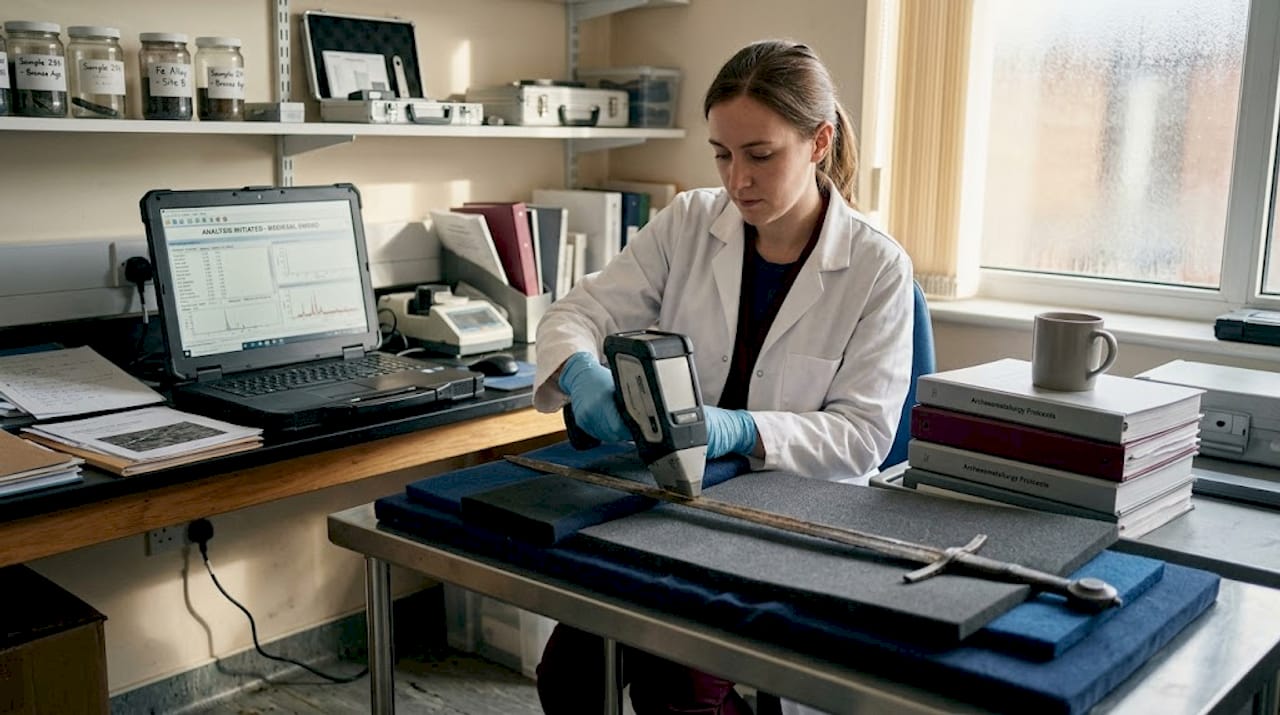
Here's a breakdown of the primary methods in use today:
| Technique | What it reveals | Invasive? | Best used for |
|---|---|---|---|
| 3D Computed Tomography (CT) | Internal voids, forge welds, construction layers | No | Hidden structure, repairs, composite builds |
| X-ray Diffraction (XRD) | Crystal structure, residual stress, phase composition | No | Hardening methods, alloy identification |
| X-ray Fluorescence (XRF) | Elemental surface composition, trace metals | No | Inlays, surface coatings, alloy verification |
| Raman Spectroscopy | Corrosion products, organic compounds | No | Age of patina, rust analysis, organic handle materials |
| Neutron Tomography | Deep internal structure with high contrast | No | Dense blades where X-rays have limits |
Each method answers a different question. CT scanning tells you how the sword was built. XRD tells you how it was treated after forging. XRF tells you what it's made of on the surface level. Used together, they create a complete forensic picture that no forger can fabricate without replicating the exact historical process.
Pro Tip: Request that any specialist performing authenticity analysis uses at least two complementary methods. Single-method testing misses details that only cross-referencing can catch. A blade that passes XRF may still fail XRD if the internal crystalline structure doesn't match the claimed manufacturing era.
For collectors building or evaluating a collection, our collectible swords checklist is a practical resource to pair with these technical insights.
With these tools explained, it's time to compare traditional approaches versus scientific ones directly.
Visual inspection versus scientific validation
Both approaches have genuine value. Neither should be dismissed. The question is knowing what each can and cannot prove.
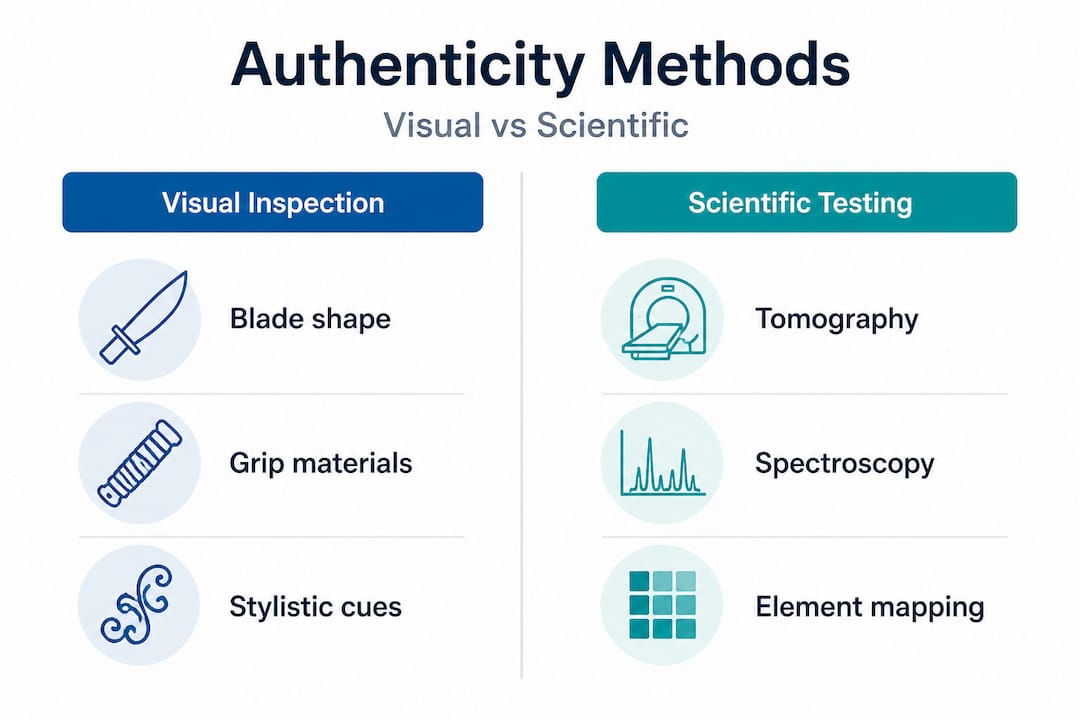
Visual inspection benefits from centuries of accumulated collector knowledge. An experienced eye recognizes when a blade's geometry doesn't match its claimed period, when a patina looks chemically applied rather than aged, or when a hilt's fastening style doesn't align with the region of manufacture. This knowledge is hard-won and real.
But visual analysis carries inherent weaknesses. It is subjective. Two equally skilled experts can disagree. It cannot reveal what's inside the blade or confirm alloy composition without destructive sampling. And skilled fakers specifically study what visual inspectors look for.
Scientific methods offer a different kind of reliability. They produce quantitative data and measurable results that don't depend on the examiner's individual judgment. Internal structural imaging and spectroscopy give consistent findings regardless of which qualified lab performs the analysis.
| Method | Pros | Cons | Reliability |
|---|---|---|---|
| Visual Inspection | Fast, low cost, builds on historical expertise | Subjective, easily deceived by skilled fakers | Moderate |
| Scientific Testing | Objective, quantitative, reproducible | Requires specialist access, can have upfront cost | High |
| Combined Approach | Maximizes accuracy, historical context plus hard data | Time-intensive, premium acquisitions only | Very High |
The smartest approach combines both. Here's how to do it effectively:
- Start with a full visual inspection. Document every observable feature: blade geometry, crossguard proportions, pommel type, grip material, and surface condition. Photograph everything before handling extensively.
- Note specific anomalies or inconsistencies. If the visual inspection raises questions, those specific areas become priority targets for scientific testing.
- Cross-reference with historical documentation. Match the sword's stylistic elements against verified examples in museum catalogs or peer-reviewed publications.
- Commission non-destructive testing for high-value pieces. XRF is often the most accessible entry point. CT scanning is worth the investment for major acquisitions.
- Evaluate the test results against both the visual findings and historical benchmarks. Contradictions between visual and scientific data are red flags that require explanation.
- Document everything in a provenance file. Test reports, photographs, expert opinions, and purchase documents together form a defensible record of authenticity.
Collectors researching authentic medieval swords for purchase should apply this combined approach before committing to significant acquisitions.
Actionable steps for collectors: Authenticity in practice
Knowing the theory is one thing. Applying it to real-world purchases requires a systematic approach. Here's what a rigorous authenticity process looks like in practice.
Before you buy, build a baseline. Research the specific sword type thoroughly. Know the expected alloy compositions, construction methods, and stylistic conventions for the claimed period and region. This knowledge makes anomalies obvious and gives context to any test data you receive.
When evaluating a potential acquisition, use this checklist:
- Request provenance documentation upfront. Legitimate sellers maintain chain of ownership records. Gaps in provenance aren't always disqualifying, but they should lower your confidence and potentially your price offer.
- Examine the patina critically. Uniform patina across all surfaces, including inside joints and on interior surfaces, is suspicious. Natural aging creates uneven distribution.
- Look at the construction details under magnification. Hand-filing leaves different mark patterns than machine grinding. Historical period and origin determine which you should see.
- Ask explicitly whether scientific testing has been conducted. If a seller dismisses this as unnecessary for an obviously authentic piece, that's a warning sign.
- For pieces above your personal value threshold, commission your own testing. Don't rely solely on documentation provided by the seller.
- Check that internal structure and composition details align with the claimed origin. A single test report covering multiple methods is far more credible than a single-method analysis.
Pro Tip: Always request materials testing documentation when buying high-value swords. If testing hasn't been done, factor the cost of commissioning it yourself into your offer price. A reputable seller will respect this due diligence rather than resist it.
Best practices for ongoing documentation include maintaining a digital and physical file for each piece in your collection. Include original purchase paperwork, all photographs, any condition reports, and scientific test results if available. If you ever sell, this documentation significantly increases value and buyer confidence.
For collectors looking to acquire with confidence and expand their knowledge before major purchases, our guides on buying swords with authenticity assurance and identifying authentic swords offer detailed pre-purchase frameworks.
With these practical steps in hand, it's worth considering what most collectors overlook when evaluating swords.
Why most collectors overlook scientific proof—and why it matters
Here's the uncomfortable truth: most sword collectors don't use scientific testing because it feels unnecessary. The piece looks right. The dealer has a good reputation. The price feels appropriate. That combination of factors creates a powerful psychological certainty that's hard to question.
But certainty isn't the same as accuracy. We've seen this pattern repeatedly in other collecting fields. The fine art world spent decades relying on attribution by eye before forensic analysis exposed widespread misattribution in major museum collections. The rare coin community built elaborate grading systems before realizing that quantitative metal analysis could catch sophisticated counterfeits those systems missed entirely.
Swords are next. As scientific testing becomes more accessible and affordable, the market will increasingly reward documented, tested pieces and discount those that rely solely on visual assessment and dealer reputation. Collectors who adopt scientific validation now are positioning themselves ahead of that shift, not just as enthusiasts but as investors protecting their acquisitions.
There's also a responsibility dimension. Authentic historical swords are physical connections to the past. Accepting a convincingly faked piece as genuine doesn't just waste your money. It potentially displaces a real artifact from the historical record and funds the forgery ecosystem that makes collecting harder for everyone.
Collecting with confidence means embracing the full toolkit available to you, visual expertise and empirical science together. The collectors who will lead the next generation of the hobby are those who treat scientific validation not as an exotic extra but as a standard part of their practice.
Top Swords: Trusted sources for authentic craftsmanship
Understanding authenticity in historical swords sharpens your eye for craftsmanship across the board. At TopSwords, every piece is built around that same standard of genuine quality.
Whether you're looking for a custom handmade battle sword crafted from Damascus steel or a historically informed piece that comes with a genuine leather scabbard, our catalog is built for collectors who care about what goes into a blade. You can also explore our full authentic knives collection for high-performance, handcrafted pieces that meet the same demanding standards. Every product description includes materials and construction details so you know exactly what you're getting.
Frequently asked questions
What is the most reliable method for sword authenticity?
Empirical, non-destructive testing such as tomography, diffraction mapping, and spectroscopy is currently the most reliable method, providing objective data on composition and manufacturing history that visual inspection cannot match.
Can visual inspection alone prove sword authenticity?
No, visual inspection provides important clues about age and style but cannot conclusively verify authenticity. Internal structure and composition analysis through scientific methods is required for definitive proof.
Are non-invasive tests safe for valuable or antique swords?
Yes, modern non-invasive methods like tomography and X-ray fluorescence cause zero damage to the artifact. These non-destructive, multi-method tests were specifically developed for use on precious and irreplaceable objects.
What documentation should I request when buying an authentic sword?
Always ask for provenance paperwork tracing ownership history and, for high-value acquisitions, scientific testing reports covering both materials composition and manufacturing analysis from a qualified specialist lab.