
Walk into any sword shop online and you'll quickly face the difference between display and functional swords without realizing it. Two blades can look nearly identical from across the room, same finish, same hilt shape, same dramatic length, yet one is built to take a full-force swing and one will shatter the moment you try. New collectors make this mistake more than veterans care to admit. This guide breaks down exactly what separates these two categories, what each is suited for, and how to make the right call before spending serious money.
Table of Contents
- Understanding what defines a functional sword
- Characteristics of display swords: beauty over performance
- Comparing display and functional swords: side-by-side differences
- Why choosing the right sword matters: safety and value considerations
- How to decide: which sword is right for you
- Why appearance can deceive: a sword expert's perspective
- Explore top-quality functional and display swords for your collection
- Frequently asked questions
Key Takeaways
| Point | Details |
|---|---|
| Purpose defines sword type | Functional swords are made for use; display swords prioritize aesthetics. |
| Materials matter | Quality steel and full tangs make functional swords safe and durable. |
| Safety first | Using decorative swords as real weapons risks breakage and injury. |
| Cost reflects quality | Functional swords cost more due to superior craftsmanship and materials. |
| Choose wisely | Match your sword choice to your intended use to ensure satisfaction and safety. |
Understanding what defines a functional sword
A functional sword is built from the ground up with one goal: surviving use. The steel is the starting point. Most quality functional blades use high-carbon steel (typically 1060, 1075, or 1095 grade) or spring steel (5160 grade), materials that flex under stress rather than snap. Stainless steel, common in display pieces, looks great but becomes brittle at sword thickness and is unsafe for actual use.
Heat treatment is where many buyers stop paying attention, but it is arguably the most critical factor. Proper tempering and quenching give the steel the right balance of hardness and flexibility. A blade that skips this step may look sharp and feel solid in hand but will fail unpredictably under real stress.
The tang, the portion of the blade that extends into the handle, is the most reliable indicator of functional intent. Full-tang swords run the full length and width of the handle and are secured with pins or rivets. This is non-negotiable for identifying quality swords meant to perform.
Key features of a functional sword:
- Steel grade: High-carbon (1060 to 1095) or spring steel (5160)
- Tang type: Full tang, pinned or riveted through the handle
- Heat treatment: Properly tempered and quenched for hardness and flex
- Edge geometry: Sharpened with a functional bevel, not just a cosmetic grind
- Balance point: Deliberately set for the sword's intended use style
- Weight distribution: Optimized for cutting mechanics or combat training
Pro Tip: Ask any seller for the steel grade and heat treatment specs before purchasing. A reputable maker will always have this information ready. If they can't answer, that tells you something important about the blade.
Characteristics of display swords: beauty over performance
Display swords operate on completely different priorities. Visual impact comes first, structural integrity comes second, and often a distant second at that. Decorative swords often use stainless steel or cheap alloys, have weak tangs, are not properly heat-treated, and are unsafe for actual use.

The tang situation in display swords deserves special attention. Many decorative pieces use a "rat-tail tang," a narrow threaded rod welded or attached to the blade. Others use glued construction where the blade is simply bonded into the handle with adhesive. Both methods look fine when the sword is hanging on a wall. Neither will hold up the moment force is applied.
Edges on display swords are almost always dull by design, which is actually safer for wall mounting and handling. But collectors sometimes mistake a decorative sword's polished, mirror-finished edge for a sharp one. The grind is cosmetic. It catches light beautifully. It won't cut cleanly through tatami or even soft material.
What display swords genuinely excel at is visual storytelling. Intricate engravings on the blade, gemstones set in the pommel, elaborate filigree on the guard, and themed artwork on scabbards are all decorative sword features you simply won't find on a working blade. Before buying, check out this collectible swords checklist for what to look for in a display-worthy piece.
Key features of a display sword:
- Steel grade: Stainless steel (420 or 440) or pot metal alloys
- Tang type: Rat-tail tang or glued/bonded construction
- Edge: Blunt, polished, or cosmetically ground but not functional
- Aesthetics: Engraving, gemstones, painted scabbards, themed motifs
- Weight: Often lighter or oddly distributed due to decorative construction
- Intended use: Wall display, cosplay props, gifting, collection pieces
Pro Tip: The best display swords are pieces that make you stop and look twice. Prioritize craftsmanship in the finish, detail work, and scabbard quality when choosing a display piece. These are the elements that hold visual value over decades.
Comparing display and functional swords: side-by-side differences
To fully grasp these differences, here's a side-by-side comparison highlighting essential features and uses of each type.
| Feature | Functional sword | Display sword |
|---|---|---|
| Steel type | High-carbon or spring steel | Stainless steel or alloy |
| Tang construction | Full tang, pinned or riveted | Rat-tail tang or glued |
| Heat treatment | Properly tempered and quenched | Usually absent or minimal |
| Edge | Sharpened, functional bevel | Blunt or cosmetic grind |
| Primary purpose | Cutting, training, reenactment | Wall display, cosplay, gifting |
| Durability | High, built for stress | Low, breaks under actual use |
| Price range | Higher due to materials and labor | Lower, designed for visual appeal |
| Weight/balance | Optimized for use | Often decorative, not ergonomic |
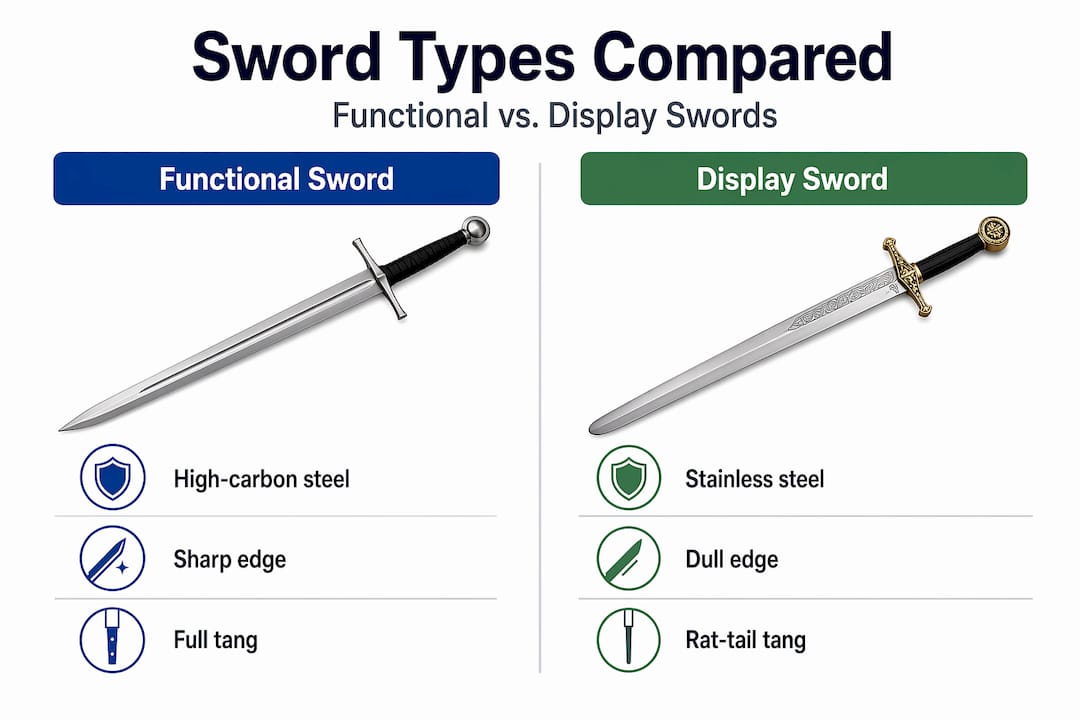
The cost gap is real and meaningful. Real swords cost more due to quality materials and craftsmanship, while decorative swords are more affordable but made for visual appeal only. A functional katana from a reputable maker might run $300 to $800 at the entry level. A display katana with elaborate fittings might be $80 to $200. The price difference reflects labor, steel, and heat treatment, not just brand markup.
For collectors weighing historical accuracy alongside usability, the buying medieval swords guide covers how to evaluate both categories within the medieval category specifically.
Additional distinctions worth knowing:
- Functional swords require regular oiling and edge maintenance; display swords need only occasional cleaning
- A functional sword's scabbard is designed for safe repeated drawing; a display scabbard is built for appearance
- Functional swords from quality makers often come with heat treatment certificates or steel specifications
Why choosing the right sword matters: safety and value considerations
The safety stakes here are not abstract. Decorative swords may look sharp but can be unsafe and break easily if used improperly. When a rat-tail tang fails mid-swing, the blade becomes a projectile. This is not a hypothetical. It happens. The handle stays in your grip and the blade goes wherever physics takes it.
Here is a practical order of priorities for making the right choice:
- Define your use first. Will you swing it, train with it, mount it, or give it as a gift? Your answer should determine every purchase decision that follows.
- Match the build to the use. Never swing a display sword, not even once, not even lightly. The construction simply cannot take it.
- Budget for the category properly. Buying a cheap "functional" sword to save money often results in a display-quality build with functional-sounding marketing copy. Research the maker.
- Verify materials before purchasing. Get the steel grade and tang type in writing if possible. Reputable sellers publish this information clearly.
- Maintain functional swords correctly. Oil the blade after handling (skin oils cause rust), store horizontally or on a proper rack, and have the edge maintained by someone experienced.
"A sword that looks dangerous and one that is dangerous are two very different things. The difference lives inside the handle and inside the steel, not on the surface."
For practical day-to-day care guidance, safe sword handling tips will help you get the most out of any sword purchase without risking injury.
How to decide: which sword is right for you
Now that you understand the differences and implications, here's a practical guide to choosing the sword best suited for your needs. Your choice depends on purpose: display swords work well for decoration and gifts, while functional swords suit practice, reenactment, and serious collecting.
How to match a sword to your situation:
- Wall display or home decor: Choose a display sword. Focus on finish, visual theme, and scabbard detail. Material strength is secondary.
- Gift for a non-collector: A display sword with strong aesthetic appeal is ideal. Safety is less of a concern since the sword will likely sit untouched.
- Martial arts training or cutting practice: You need a functional sword, full stop. Do not cut corners here.
- Historical reenactment or HEMA (Historical European Martial Arts): Requires battle-ready construction. Look for swords specifically rated for full-contact use or sparring.
- Serious long-term collection: Consider choosing medieval swords or similar historical categories that hold value and represent genuine craftsmanship.
- Cosplay or convention use: Display swords work well here. Check event rules; most conventions restrict sharp blades regardless of category.
Pro Tip: The functional swords vs display swords divide is not always about quality in the traditional sense. Some of the best display swords are exquisitely crafted objects worth serious money. The category is about intended use, not about which is "better."
Why appearance can deceive: a sword expert's perspective
Here's something most beginner collectors discover the hard way: ornate swords feel premium. The more detail on the crossguard, the more gems in the pommel, the more dramatic the blade etch, the more the brain interprets it as valuable and capable. That feeling is exactly backwards from reality.
The most capable functional swords often look almost plain by comparison. A well-made 1075 high-carbon katana with a simple rayskin handle and a matte black saya (scabbard) will outperform an elaborately decorated display piece in every measurable category of actual use. The craftsmanship went into the steel and the geometry, not into the visual theater.
Decorative swords may appear detailed or sharp but are often unsafe due to weak tangs and improper heat treatment. Functional swords prioritize reliability and safety. That sentence should be printed somewhere visible before any new collector buys their first blade.
The wasted investment angle is underappreciated. Collectors who buy display swords expecting functional performance end up frustrated, often with broken hardware and a bad experience that puts them off the hobby. Conversely, buyers who spend serious money on a functional battle sword and then mount it on a wall have made a choice that is entirely valid, because functional construction guarantees durability over decades of display. The reverse does not hold. A display sword will not last through actual use, ever.
The smarter long-term position: build a collection that has a clear philosophy. Display pieces for visual storytelling, functional pieces for actual engagement with the craft. Use quality sword identification skills to vet both categories honestly, and you'll never spend money on the wrong sword again.
Explore top-quality functional and display swords for your collection
Whether you're ready to add a battle-tested functional blade or a showpiece that commands attention on any wall, the right starting point is a collection built on genuine craftsmanship.
For serious functional use, the handmade Damascus steel battle sword delivers hand-forged performance with a leather sheath built for real handling. If you're drawn to display and themed pieces, the anime swords collection covers some of the most detailed replica work available for collectors and cosplayers. And for history-focused collectors who want both craft and context, the medieval swords range spans everything from display-quality replicas to battle-ready construction, all with clear material specifications so you know exactly what you're getting.
Frequently asked questions
Can I use a decorative sword for cutting practice?
No. Decorative swords are not safe for actual use because weak tangs and absent heat treatment make them prone to catastrophic failure under stress.
What materials are functional swords typically made from?
Functional swords are made from high-carbon or spring steel, grades like 1060, 1075, 1095, or 5160, which provide the strength and flex necessary for real use.
Why do functional swords cost more than decorative ones?
The price gap reflects the cost of quality steel, proper heat treatment, and skilled construction. Real swords are more expensive because every structural element is built to perform, not just to look good.
Can a sword be both display-worthy and functional?
Yes, some handcrafted pieces balance genuine construction quality with refined aesthetics. The key is verifying the tang type, steel grade, and heat treatment specifications rather than judging by appearance alone.