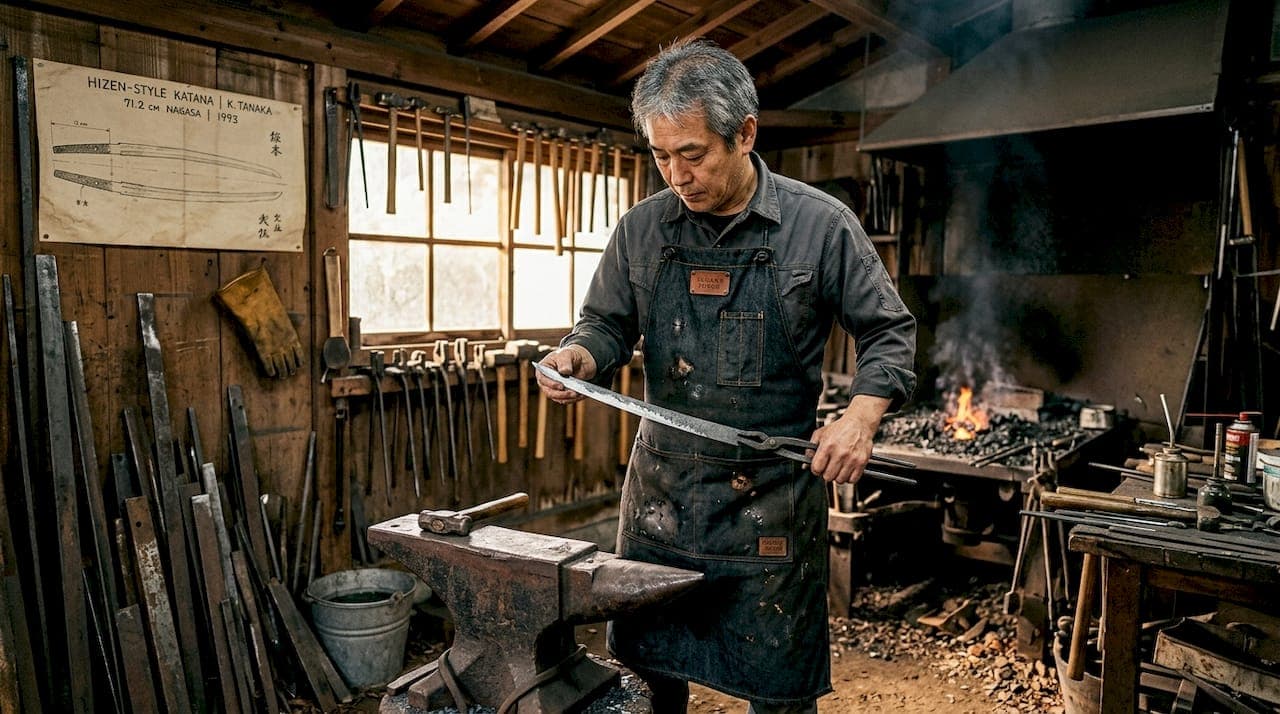
Centuries-old sword forging methods still rival modern metallurgy in ways that genuinely surprise even seasoned collectors. The assumption that newer always means better simply doesn't hold in the world of blades. A Japanese katana forged through traditional tamahagane smelting and differential hardening can outperform many factory-made swords in flexibility and visual artistry, even today. Whether you're evaluating your first hand-forged piece or adding to an established collection, understanding the mechanics behind both traditional and contemporary forging techniques will sharpen your eye for craftsmanship, quality, and lasting value.
Table of Contents
- Origins and evolution of sword forging
- Core steps of traditional sword forging
- Modern sword forging techniques and materials
- How to evaluate sword craftsmanship: Key features for collectors
- Why the romance of traditional sword forging endures despite modern advances
- Explore and collect exceptional forged swords
- Frequently asked questions
Key Takeaways
| Point | Details |
|---|---|
| Traditional techniques endure | Ancient forging methods continue to produce beautiful, functional swords valued by collectors. |
| Modern steel advantages | Contemporary metallurgy delivers excellent edge retention and uniform toughness for today’s swords. |
| Visual details signal skill | Patterns like hamon and hada provide insight into a smith’s craftsmanship and a sword’s quality. |
| Evaluate before you buy | Knowledge of forging methods helps collectors distinguish genuine, high-quality swords from reproductions. |
Origins and evolution of sword forging
After understanding why sword forging matters, it's essential to see how history shaped the competing techniques collectors encounter today.
Sword making began thousands of years ago when smiths worked with whatever iron ore and fuel they could find locally. Early bloomery furnaces produced iron with inconsistent carbon content, which meant smiths had to develop clever techniques to work around the material's natural flaws. Folding and layer welding emerged precisely because the available iron was uneven. By folding the metal repeatedly and hammering out the layers, smiths could redistribute carbon, remove slag inclusions, and produce a blade that performed far better than the raw material suggested possible. Traditional methods optimized blade properties for whatever materials were available, turning a limitation into an art form.
Different cultures developed strikingly distinct approaches based on their environments, combat needs, and available resources:
- Japanese tradition: Tamahagane steel, produced in a clay furnace called a tatara, became the foundation for katana forging. Smiths sorted high and low carbon steel pieces, then welded, folded, and differentially hardened the blade.
- Norse and Viking tradition: Pattern-welded blades combined iron and steel rods twisted and welded together, producing strength alongside dramatic visual patterns.
- European medieval tradition: Smiths worked with bloomery iron and later crucible steel, developing single-edged and double-edged swords shaped for specific combat roles, from the arming sword to the greatsword.
The shift toward industrial metallurgy in the 18th and 19th centuries changed everything. Steel production became centralized and consistent. Factories could produce steel with precise, repeatable carbon content and alloy compositions. Heat treatment became a science rather than a craft passed down through generations.
"The industrial era didn't eliminate traditional sword forging. It forced smiths to define what made their craft irreplaceable, and the answer lay in artistry, intentionality, and the connection between maker and material."
Collectors who understand this history can recognize the context behind every blade, including the deep connection between sword craftsmanship traditions and the cultural values that shaped them.
Core steps of traditional sword forging
With this historical context, let's walk through the main steps a traditional sword smith follows to turn raw iron into a legendary blade.
Traditional forging is genuinely slow work. A skilled Japanese sword smith may spend weeks on a single katana. Each step carries specific purpose, and skipping or rushing any one of them changes the final blade's character. Here's how the process typically unfolds:
- Smelting raw material: Traditional Japanese smiths begin by producing tamahagane in a clay tatara furnace over three days, burning charcoal and iron sand together. The resulting steel contains varying carbon levels, which the smith then sorts by hand.
- Folding and welding layers: High and low carbon pieces are welded together, then folded and hammered repeatedly, often 8 to 16 times. This process removes impurities, distributes carbon more evenly, and creates the distinctive hada (grain pattern) visible on finished blades.
- Shaping the blade profile: Once the layered billet reaches the right character, the smith hammers it into the rough shape of the sword, including the curvature (sori), point geometry (kissaki), and basic thickness distribution.
- Clay coating and quenching: This is the step that sets Japanese swords apart from nearly every other tradition. The smith applies a thick clay slurry to the spine and a thin coat to the edge, then heats the blade and plunges it into water. The differential cooling rate between edge and spine creates two distinct zones: a hard, crystalline martensite edge and a tougher, more flexible pearlite spine.
- Polishing and finishing: A master polisher may spend 100 or more hours bringing out the hamon (hardening line), hada grain, and the blade's final geometry using a series of increasingly fine stones.
The results are measurable. Tamahagane edge hardness typically reaches 55 to 67 HRC, while the spine measures 0 to 30 HRC, a range intentionally designed to absorb shock without shattering.
Pro Tip: When examining a traditionally forged blade, hold it at a low angle to light and look for the hamon. A genuine hamon has subtle, organic variation along its length. A cheap acid-etched imitation will look flat and uniform under the same light.
Understanding these steps helps collectors recognize exactly what they're seeing when they study a blade in person. More details on the full production process are covered in this guide on how swords are made.
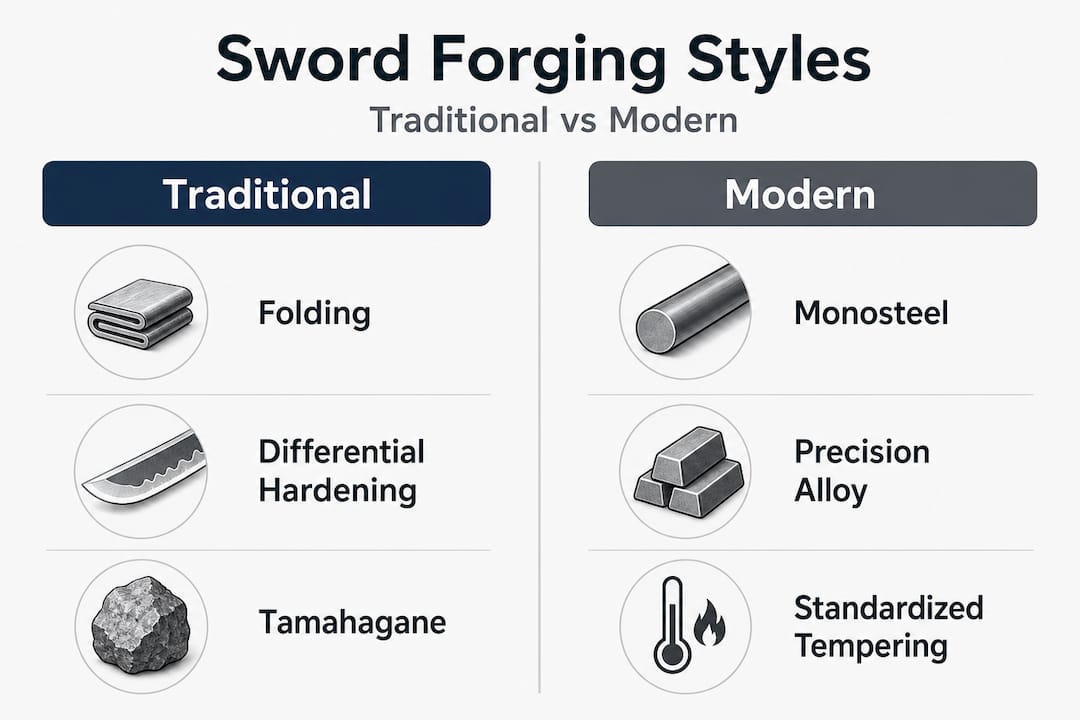
Modern sword forging techniques and materials
Once you understand the classic process, it's fascinating to see how today's technology both simplifies and strengthens the approach.
Modern sword making draws on two centuries of metallurgical science. Steel mills now produce alloys with extremely tight carbon and alloying element tolerances, meaning a blade smith working with 1075 high carbon steel, T10 tool steel, or 9260 spring steel knows exactly what the material will do under heat and stress. This predictability removes the guesswork that traditional smiths spent decades mastering.
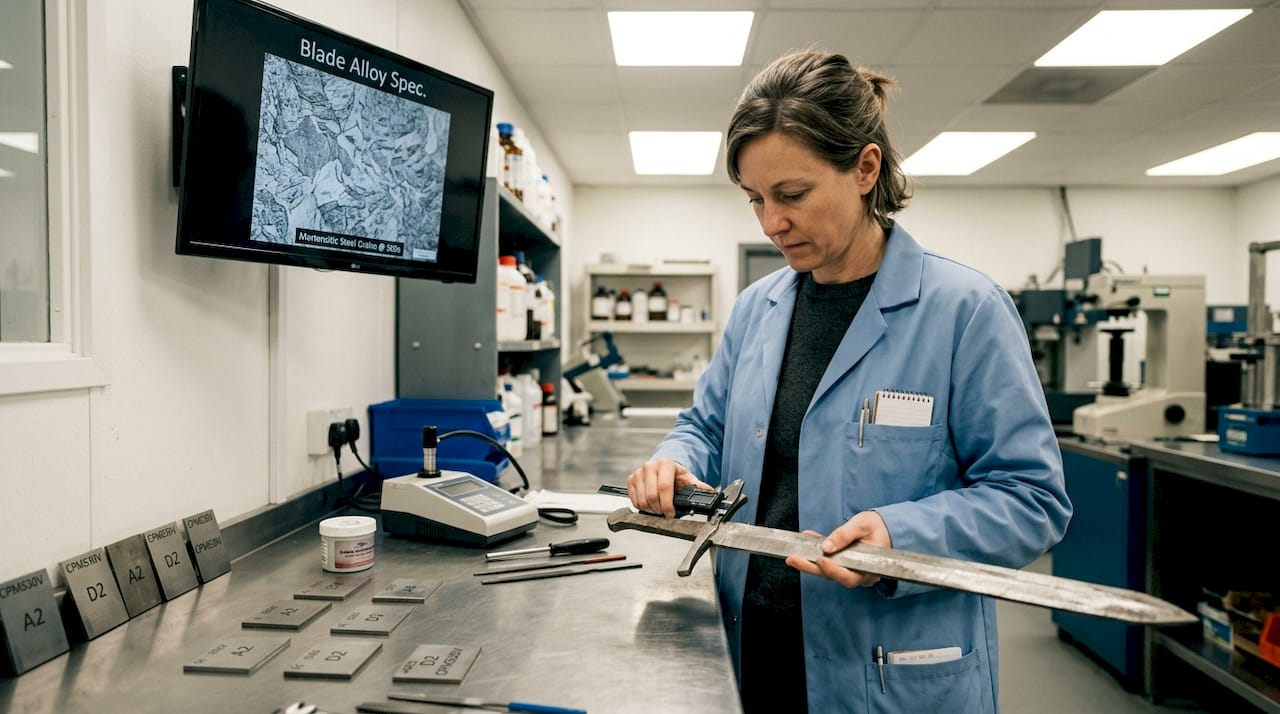
Modern monosteels are the most common starting point for contemporary production swords. A monosteel blade starts as a single, uniform bar of steel. Because the material is already homogenous, modern monosteels achieve higher uniform toughness throughout the entire cross section without the folding and welding process that traditional smiths relied on to work around material imperfections.
| Feature | Traditional forged blade | Modern monosteel blade |
|---|---|---|
| Starting material | Tamahagane or bloomery iron | High carbon or alloy steel bar |
| Folding required | Yes, 8 to 16+ times | No |
| Carbon distribution | Variable (intentional) | Uniform and precise |
| Edge hardness | 55 to 67 HRC | 55 to 65 HRC (consistent) |
| Grain pattern (hada) | Visible, unique | Absent |
| Production time | Weeks to months | Days |
| Toughness | Differential (edge/spine) | Uniform throughout |
Beyond monosteel, modern forging techniques include:
- Stock removal: A blade is ground from a steel bar using belt grinders, files, and abrasives rather than hammer forged. This produces consistent geometry but lacks the grain refinement of forging.
- CNC machining: Computer-controlled milling machines cut blade profiles with extreme precision, particularly useful for production runs of replica swords.
- Damascus and pattern welded steel: Modern smiths still use layer welding, but with precise alloy control. Two or more steel types are forge-welded, twisted, and drawn out to create layered patterns. Today's Damascus often uses 1084 and 15N20 steel, creating bold contrast between nickel-rich bright layers and darker carbon steel.
This last point matters enormously for collectors. A hand-forged Damascus steel katana carries both modern metallurgical benefits and the visual artistry of traditional layer welding. You also see this approach in medieval swords that combine historical aesthetics with high-performance modern steels.
Key statistic: Modern Damascus steel can contain anywhere from 50 to over 400 layers depending on how many times the billet is folded, with each additional fold multiplying the visible layer count.
The practical advantage of modern techniques isn't just performance. It's also accessibility. Collectors can now acquire swords that genuinely perform well, look stunning, and won't break after occasional use, at price points that would have been impossible for traditionally forged blades alone.
How to evaluate sword craftsmanship: Key features for collectors
Now that you've seen both traditional and modern forging paths, here's how you can translate that knowledge into practical evaluation skills.
The best collectors approach a new sword the way a mechanic approaches a used car. They know what to check, in what order, and what each finding tells them about the overall quality.
Visual clues to examine first:
- Hamon: A genuine hamon shows differential hardening. Hamon patterns and hada grain reveal the smith's skill and process. Look for organic, uneven edges to the hardening line rather than a perfectly uniform band.
- Hada: On traditionally forged blades, hold the flat under bright light and look for a subtle wood grain texture. This is the folded layer structure coming through the polish.
- Geometry and symmetry: Sight down the blade from tip to handle. Any twist or lateral curve that shouldn't be there indicates uneven heat treatment or poor grinding.
- Surface finish: High-quality swords show a consistent, mirror or satin finish free of grind marks, deep scratches, or pitting near the edge.
| Quality indicator | What it tells you | Red flag |
|---|---|---|
| Hamon clarity | Real differential hardening | Looks identical on both sides (etched) |
| Hada grain | Genuine layer welding | Absent on supposed folded steel |
| Edge symmetry | Careful grinding and polish | Wavy or inconsistent edge bevel |
| Balance point | Thoughtful weight distribution | Blade-heavy without purpose |
| Maker's marks | Authenticity and provenance | None provided with high asking price |
Performance clues for functional swords:
- Balance point should sit 3 to 5 inches from the guard on a katana, further for cutting-oriented blades.
- Flex the blade gently by hand and feel for spring. A properly tempered blade should return to center.
- Edge retention under controlled testing tells you more than visual inspection alone.
Documentation adds real collector value. A sword accompanied by a certificate of authenticity, photos of the forging process, or a known maker's signature carries provable provenance. This elevates it above a similar unsigned piece on the market.
Pro Tip: Cross-reference the claimed steel type with the blade's visual and physical characteristics. A claimed 1095 high carbon blade should show discoloration or a patina with mild acid exposure. A stainless steel blade won't. Simple checks like this save collectors from misleading product descriptions.
For a complete walkthrough of what separates genuine quality from imitation, the quality sword guide covers additional benchmarks. The deeper connection between material choices and value is explored in detail when you study craftsmanship and value across different blade traditions.
Why the romance of traditional sword forging endures despite modern advances
Armed with practical criteria, it's worth stepping back to reflect on what continues to make sword forging such a magnetic art for collectors and enthusiasts.
Here's the honest truth: modern metallurgy wins on consistency. A blade produced from 9260 spring steel using precise heat treatment protocols will outperform a traditionally forged piece in edge retention, uniformity, and reproducibility. That's not debatable.
But consistency is not the same as character.
When a sword smith folds tamahagane over two weeks of focused work, they're making hundreds of small decisions in real time, reading the color of hot steel, adjusting hammer angle, judging quench timing by eye and sound. Those decisions leave a record in the blade itself. The hamon is literally the visible result of the smith's judgment under pressure. No two are identical. That's not a manufacturing limitation. It's a feature.
Collectible swords blend both history and cutting-edge technology, and the best examples on today's market show exactly this combination. Contemporary smiths who studied under traditional masters, and who also understand modern metallurgy, are producing blades that outperform historical examples on every measurable metric while preserving the artistry that makes them collectible.
The danger in fixating purely on performance data is that you start treating swords like industrial tools rather than cultural artifacts and expressions of skill. A collector who only asks "what's the Rockwell hardness?" is missing the deeper question: what does this blade tell you about the person who made it and the tradition they inherited?
The most rewarding collections include both. A precisely heat-treated modern Damascus battle sword alongside a hand-polished katana in traditional style gives you the full picture of what human ingenuity has achieved with steel, charcoal, and a hammer. That breadth, achieved through exploring craftsmanship across traditions, is what separates serious collectors from casual buyers.
Explore and collect exceptional forged swords
If you're ready to move from learning to collecting, finding pieces that genuinely reflect both tradition and technical mastery is the natural next step.

At TopSwords, the focus is exactly on this intersection of artistry and performance. The Damascus steel battle sword showcases hand-forged layered steel with a leather sheath, combining striking visual patterns with real structural integrity. For collectors drawn to historical forms with creative pattern work, the Brute Elja pattern replica offers an inspired take on historical blade design in hand-forged Damascus steel. Both pieces represent the kind of work that bridges old-world technique with modern materials, exactly what a knowledgeable collector should seek out.
Frequently asked questions
What makes folded steel important in sword forging?
Folded steel removes impurities, improves toughness, and creates unique grain patterns prized by collectors. Traditional methods optimized blade properties for available materials, and the folding process was central to achieving consistency from uneven iron sources.
How do modern monosteel swords compare to traditional swords?
Modern monosteel swords offer greater edge retention and consistent toughness throughout the blade, while traditional swords excel in craftsmanship, visual character, and historical value. Modern monosteels achieve higher uniform toughness but lack the differential hardening artistry of traditional methods.
Why do collectors look for hamon patterns on swords?
Hamon patterns indicate genuine differential hardening and reveal the level of the smith's skill, which enhances both the blade's visual appeal and its collectibility. Hamon patterns and hada grain are among the most reliable indicators of authentic traditional forging technique.
What is the typical hardness of a tamahagane sword edge and spine?
A tamahagane edge hardness typically measures 55 to 67 HRC, providing a sharp, wear-resistant cutting surface, while the spine measures 0 to 30 HRC to absorb shock and prevent catastrophic cracking under stress.