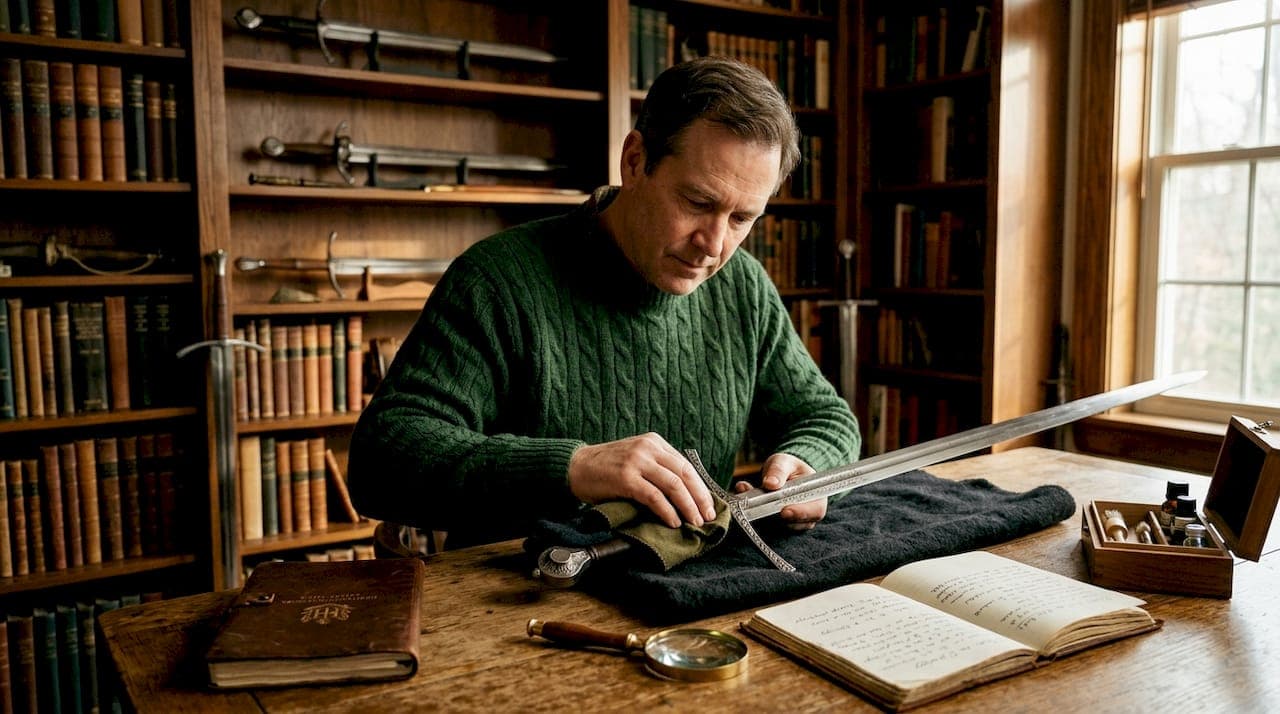
Standing in front of a display case filled with medieval swords, most people see blades. Serious collectors see centuries of military evolution, metallurgical craft, and design philosophy frozen in steel. The difference between a Type XII and a Type XV is not just a few centimeters of taper — it represents the entire shift from cut-focused warfare to the thrust-heavy demands of plate armor combat. Whether you collect for display, cosplay, or deep historical appreciation, understanding what separates one sword type from another is what transforms a random assortment of blades into a truly meaningful collection.
Table of Contents
- How to identify and evaluate medieval swords
- Key types of medieval swords explained
- Medieval sword comparison: Features at a glance
- Tips for collecting and displaying medieval swords
- Why understanding sword types sets collectors apart
- Find your next medieval sword
- Frequently asked questions
Key Takeaways
| Point | Details |
|---|---|
| Understand sword anatomy | Knowing the parts and construction boosts your ability to select and authenticate swords. |
| Oakeshott typology matters | Classification by typology helps you appreciate historical context and distinguish types for display. |
| Compare before you buy | Quickly referencing cut, thrust, size, and grip gives you confidence in sword selection. |
| Authenticity is in the details | Focus on fuller shape, taper, and provenance to ensure your sword is true to period. |
How to identify and evaluate medieval swords
Before comparing types, you need a shared vocabulary. Medieval swords have consistent anatomical features, and knowing each part lets you evaluate any blade you encounter with confidence.
The blade is the core of the sword, divided into the forte (the strong lower third near the guard, used for blocking) and the foible (the flexible upper third near the tip, used for cutting and thrusting). The fuller is the groove running along the flat of the blade. Contrary to popular belief, its main purpose is weight reduction without sacrificing structural strength, not "blood grooves." The crossguard protects the hand from opposing blades. The grip is the handle, usually wrapped in leather or wire. The pommel counterbalances the blade and keeps your hand from slipping. The tang is the unseen extension of the blade that runs through the grip — and it is arguably the most important structural component.
For collectors and display enthusiasts, tang construction is a make-or-break detail. A full tang construction extends the full length of the handle and provides maximum durability and structural integrity. Partial tangs are cheaper to produce and are common in decorative pieces, but they can fail under any real stress. When assessing a replica, always ask about tang specification first.
What to check when evaluating any medieval sword:
- Fuller depth and length: Does it match the period type?
- Blade taper: Consistent or abrupt? Early types taper gently; later thrust types taper sharply.
- Pommel shape: Disc, wheel, brazil nut, or lobated? Each is period-specific.
- Crossguard style: Straight, curved, or angled? Historical context matters.
- Balance point: The balance point ideally falls 10 to 13 centimeters from the guard for proper handling feel.
- Tang construction: Full tang is essential for any serious replica or collectible.
- Surface finish: Avoid over-polished blades that look modern and lose historical character.
The Oakeshott typology, developed by medieval arms scholar Ewart Oakeshott in the 20th century, is the standard classification system for European medieval swords. It organizes swords by blade geometry, fuller shape, cross-section, and overall form into numbered types (I through XXII), giving collectors a precise, internationally recognized reference framework.
Pro Tip: When examining a replica for purchase, hold it naturally and check where the balance point falls. A well-made piece will feel like an extension of your arm, not a dead weight. Poor balance is the fastest sign of a rushed or low-quality build.
Key types of medieval swords explained
With criteria set, let's examine the hallmark types of medieval swords you'll encounter in collections, museums, and quality replica catalogs.
Medieval swords did not evolve randomly. Each design shift responded directly to changes in armor, combat doctrine, and metallurgical capability. Understanding this context makes every sword type more interesting and far easier to identify.
1. The arming sword (Oakeshott Types X through XIV) This is the classic single-handed knightly sword of the early medieval period. It features a broad, double-edged blade with a fuller running most of the blade length, optimized for cutting. It is what most people picture when they think "knight's sword." Practical, versatile, and balanced, it was the standard sidearm of European knights from roughly the 10th through the 13th century.
2. The Oakeshott Type XII A refined evolution of the early arming sword, the Type XII features a broad, tapered blade with a long fuller and measured between 75 and 90 centimeters, weighing around 1.1 to 1.4 kilograms. It was primarily cut-focused and dominated the 12th through early 14th century battlefield. Its fuller runs nearly the full blade length, making it lighter than it looks while maintaining cutting edge rigidity.
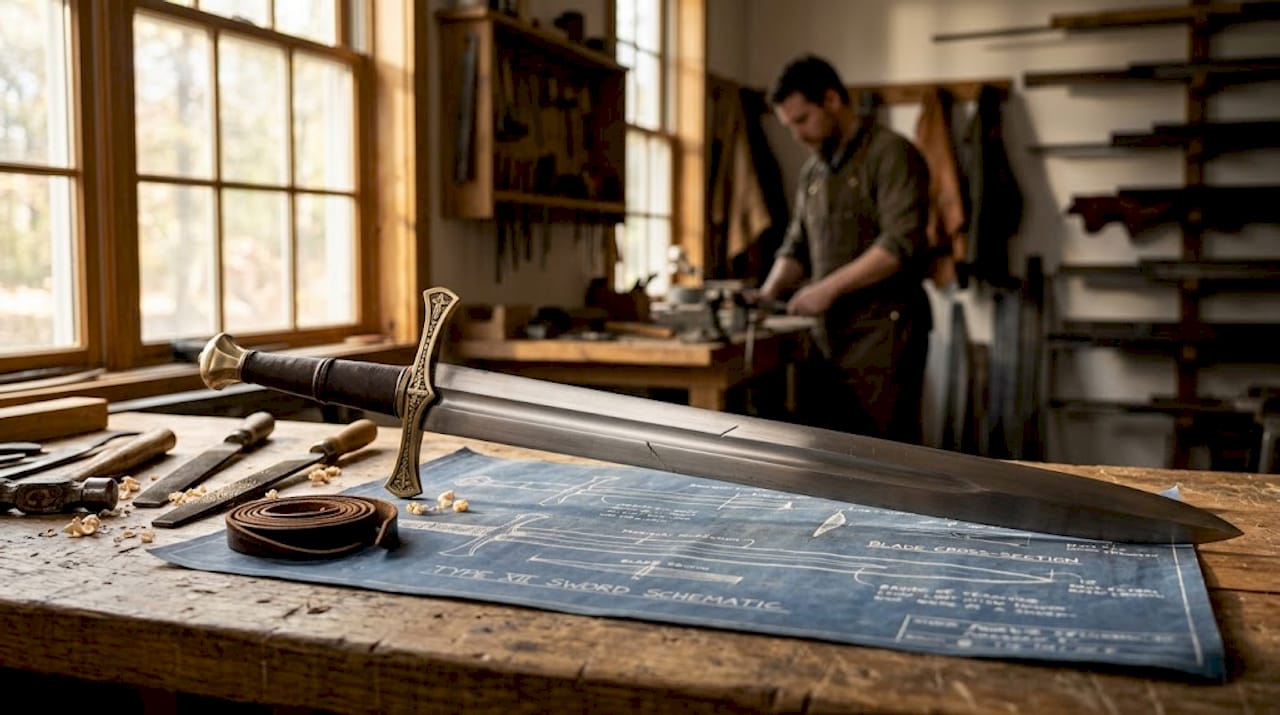
3. The Oakeshott Type XIIIa The Type XIIIa takes the arming sword concept wider. It features parallel blade edges that create a broader profile optimized for heavy cutting power against lightly armored opponents. Its grip is slightly longer, allowing occasional two-handed use when extra force was needed. This sword dominated the 13th century and is closely associated with the Crusades period.
4. The longsword (Oakeshott Types XV through XXII) The longsword is the most celebrated medieval sword type, and for good reason. With a blade length of 36 to 43 inches and a grip long enough for one or two hands (the "hand-and-a-half" configuration), it offered remarkable versatility. Longswords were optimized for both cutting and thrusting, making them effective against a wide range of armored and unarmored opponents throughout the 14th to 16th centuries. They are the dominant sword of the late medieval period and the most popular type among collectors today.
5. The Oakeshott Type XV and XVa These are purpose-built thrusting swords. The Type XV features a narrow, stiff diamond cross-section blade that tapers aggressively to a sharp point, designed to find gaps in plate armor. It represents the direct response to the rise of full plate armor in the 14th and 15th centuries. The XVa variant is longer and even more thrust-optimized.
6. The estoc The estoc is the extreme end of anti-armor design. A purely thrusting weapon, its blade has a stiff triangular or square cross-section with no cutting edge whatsoever. It was designed exclusively to penetrate plate armor through gaps at the visor, armpit, or groin. Used from the 14th through 15th centuries, it represents medieval engineering at its most specialized.
Collector pros and cons at a glance:
- Arming sword: Iconic look, great for display, widely available as quality replicas, historically versatile. Downside: less dramatic visual presence than a longsword.
- Type XII/XIIIa: Historically rich, excellent for 12th to 13th century collection themes. Downside: fuller geometry hard to fake well, so poor replicas are obvious.
- Longsword: Maximum visual impact, highly recognizable, strong cosplay value. Downside: requires more display space.
- Type XV/estoc: Highly specialized, unique conversation pieces. Downside: less immediately recognizable to casual viewers.
Browsing our medieval swords collection gives you a strong sense of how these types translate into real, craftsman-made pieces. If you want a contrast in design philosophy, comparing a longsword replica to a Roman-inspired gladius replica shows just how dramatically sword design changed across centuries and civilizations.
Medieval sword comparison: Features at a glance
Now that you know the main types, compare their key features side by side.
The Oakeshott classification evolved directly with armor technology, shifting from broad cut-focused early types to narrow, stiff, thrust-optimized designs as plate armor became more prevalent in the 14th and 15th centuries. This single fact explains almost every design difference you see in the table below.
| Sword type | Blade length | Typical weight | Primary function | Grip style | Historical era |
|---|---|---|---|---|---|
| Arming sword (Type X-XIV) | 70-80 cm | 1.0-1.3 kg | Cutting | Single-hand | 10th-13th c. |
| Type XII | 75-90 cm | 1.1-1.4 kg | Cutting | Single-hand | 12th-14th c. |
| Type XIIIa | 80-95 cm | 1.2-1.5 kg | Heavy cutting | Hand-and-a-half | 13th c. |
| Longsword (Type XV-XXII) | 91-110 cm | 1.2-1.8 kg | Cut and thrust | Hand-and-a-half/two-hand | 14th-16th c. |
| Type XV/XVa | 85-100 cm | 1.3-1.6 kg | Thrusting | Hand-and-a-half | 14th-15th c. |
| Estoc | 90-105 cm | 1.4-1.8 kg | Thrust only | Two-hand | 14th-15th c. |
| Medieval short sword | 35-50 cm | 0.7-1.0 kg | Close combat | Single-hand | Various |
The weight ranges may surprise you. Medieval swords were not the massive unwieldy weapons Hollywood portrays. A well-balanced longsword at 1.5 kilograms feels far lighter in hand than a modern sledgehammer, precisely because of how weight is distributed along the blade and grip.
For collectors working with limited display space, a medieval short sword can anchor a themed display without dominating an entire wall. For maximum presence, a highland claymore or longsword commands attention from across a room.
Pro Tip: Save this comparison table as a reference before your next acquisition. When a seller lists a sword without a type designation, you can use blade length, weight, and grip style to narrow it down yourself. A narrow, stiff blade over 90 cm with an aggressive taper almost always indicates a late medieval thrust-oriented design.
Tips for collecting and displaying medieval swords
With a full picture of types and comparisons, here's how to make the best collecting and display choices.
Authentication is where casual collectors get tripped up most often. A sword can look period-accurate and still be entirely wrong in the details. Here is what to verify before any purchase:
Authentication checklist:
- Fuller geometry matches the claimed type. A Type XII should have a fuller running nearly the full blade length; a Type XV should have minimal or no fuller.
- Blade taper is consistent with function. A cut-focused sword has gentle taper; a thrust-focused design tapers sharply toward a stiff point.
- Balance point falls in the 10 to 13 centimeter range from the guard for most single-hand and hand-and-a-half types.
- Pommel style matches the period. Do not accept a wheel pommel on a supposed 15th century design without research.
- Avoid over-polished finishes. Museum-quality replicas use controlled finishes that reflect historical patina, not mirror-shine modern polishing that strips the blade of historical character.
- Confirm full tang construction. This matters for both structural integrity and long-term durability.
Display best practices:
Mounting matters as much as the sword itself. Horizontal wall mounts show off the full blade profile and are ideal for longswords and claymores. Angled mounts at 45 degrees suit shorter types and add visual dynamism to a display. Use UV-filtering glass or cases if your collection space receives direct sunlight — ultraviolet light accelerates handle material degradation over time.
For cosplay and event use, weight distribution and grip comfort become critical. A quality replica sword with proper balance handles completely differently than a cheap prop, and that difference is immediately obvious in photos and on the convention floor.
Maintenance tips for replica swords:
- Wipe the blade with a lightly oiled cloth after handling to prevent moisture-driven oxidation.
- Keep leather grips conditioned with appropriate leather oil.
- Store in a dry environment; humidity is the primary enemy of carbon steel blades.
- Check pommel and crossguard fittings annually for any loosening.
Pro Tip: The biggest pitfall in the modern replica market is conflating "decorative" and "functional." Decorative swords often use low-quality steel or rat-tail tangs (a very thin, narrow tang) disguised under attractive hilts. Always ask for the tang specification and blade steel grade before purchasing.
Why understanding sword types sets collectors apart
Most people who buy a medieval sword pick it because it looks cool. There is nothing wrong with that. But collectors who invest time in learning Oakeshott typology experience something fundamentally different. They see a Type XII and immediately understand the 12th century battlefield it came from — the weight, the cutting geometry, the wider grip all make historical sense.
There is also a persistent misconception worth addressing directly. Terms like "bastard sword" and "broadsword" are commonly used but are not Oakeshott type designations. "Bastard sword" informally refers to hand-and-a-half longswords, and "broadsword" has been applied so loosely throughout history that it means almost nothing precise. Collectors who rely on these terms often end up with misidentified pieces in their collections.
The more interesting insight: every time armor technology changed, sword design responded within a generation. Plate armor dominated by the 1350s, and thrust-optimized blades like the Type XV appeared almost immediately. Studying those relationships through historically-inspired swords gives you a lens for understanding medieval military history that no general history textbook provides.
Knowing the difference between a Type XIIIa and a longsword is not just academic trivia. It tells you which 50-year window in medieval history the piece represents, which combat style it was built for, and which opponents it was designed to defeat. That depth of knowledge is what transforms a wall of blades into a curated collection with a genuine story to tell.
Find your next medieval sword
Ready to apply your new expertise?
At TopSwords, we carry a curated range of handcrafted replicas built with the craftsmanship and attention to detail that serious collectors demand. From single-handed arming swords to full longswords, every piece is selected for historical accuracy, authentic finish, and durable construction.
Browse our medieval swords collection to find the type that matches your collection theme or cosplay vision. If you want a statement piece in Damascus steel, our handmade battle sword delivers exceptional craftsmanship with full tang construction and a leather sheath. Prefer something from the world of fantasy? Our anime and fantasy swords bring the same quality standards to iconic fictional designs. Whatever your focus, your next acquisition starts here.
Frequently asked questions
What was the most common type of medieval sword?
The arming sword and longsword were among the most common types throughout the medieval period, with longswords becoming dominant from the 14th century onward as armor and combat styles evolved.
How can you tell if a sword is a true medieval design?
Look for historically accurate features including the correct fuller, pommel shape, crossguard style, blade taper, and overall geometry consistent with known sword typologies for the claimed period.
Why do collectors care about Oakeshott typology?
The Oakeshott classification gives collectors a precise framework for identifying, dating, and comparing medieval swords by their blade and hilt features, which directly enhances both collecting accuracy and display credibility.
Are modern replica swords durable enough for display or use?
High-quality replicas with full tang construction and proper high-carbon or stainless steel blades offer genuine durability suitable for display, safe handling, and cosplay events.