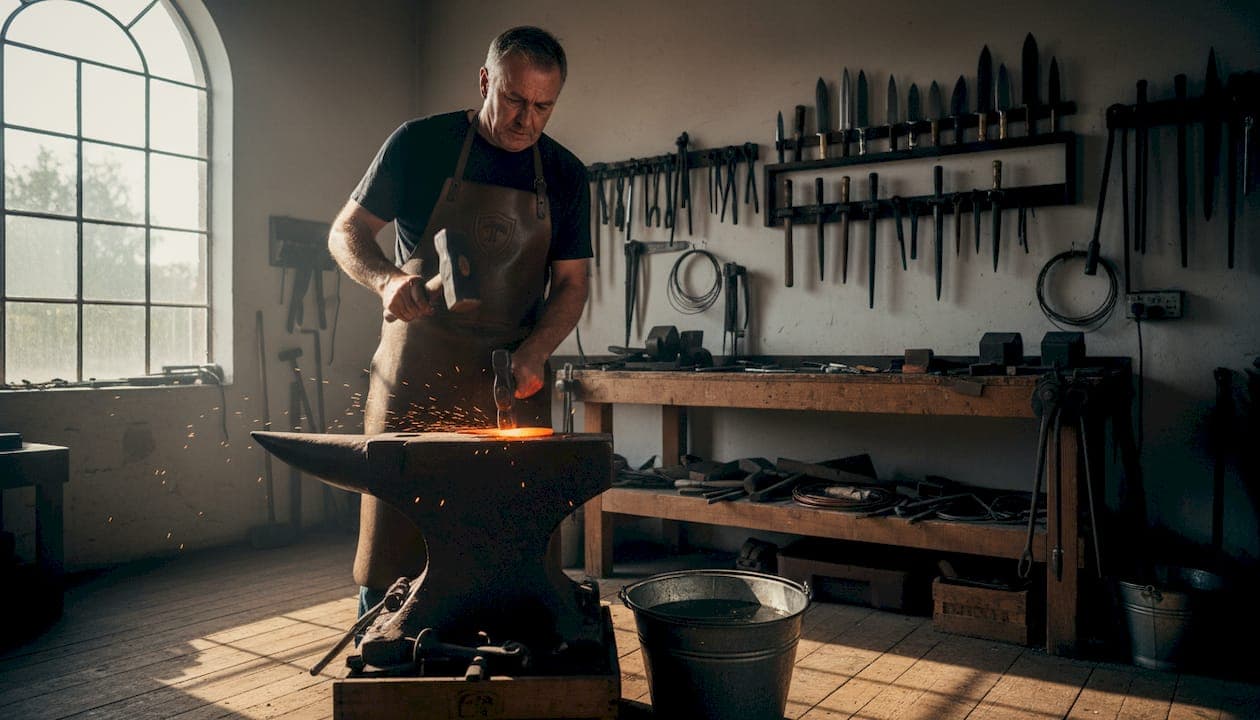
Most people picture a bladesmith as someone who bangs metal in a garage or hammers out decorative wall pieces for Renaissance fairs. That image is wildly incomplete. Bladesmiths are specialized metalworkers who produce knives, swords, and daggers through demanding forge-and-hammer workflows that blend materials science, thermal physics, and artistic judgment. Their contributions shaped military history, influenced trade economies, and continue to drive modern collecting and cosplay culture. Understanding what bladesmiths actually do changes how you see every blade hanging on a wall or strapped to a cosplayer's back.
Table of Contents
- What is a bladesmith? Tradition and evolution
- Step-by-step: How bladesmiths transform raw steel into weapons
- Bladesmiths in weapon production: Collaboration, rivalry, and specialization
- Bladesmiths today: Influence on collectors, cosplay, and popular culture
- Why true mastery in bladesmithing is overlooked
- Bring swords and bladesmithing art into your collection
- Frequently asked questions
Key Takeaways
| Point | Details |
|---|---|
| More than sword making | Bladesmiths excel at creating a full range of bladed weapons and tools, not just swords. |
| Mastery is science and art | Critical steps like heat treatment separate true masterpieces from ordinary weapons. |
| Specialization shaped history | Guilds and rival craft traditions drove innovation and quality in weapon making. |
| Pop culture impact | Bladesmithing tradition is alive in modern cosplay, collecting, and custom weapon communities. |
| Skill retains value | Bladesmith-made pieces often command high respect and enduring worth among enthusiasts. |
What is a bladesmith? Tradition and evolution
With those misconceptions countered, it's vital to clarify what a bladesmith actually does and how the practice has evolved over centuries of weapon making.
A bladesmith is an artisan who specializes in creating knives, swords, daggers, and similar cutting tools, primarily through the process of forging. Forging means heating steel until it reaches a workable temperature and then shaping it with a hammer on an anvil. This is fundamentally different from just cutting a blade outline out of a flat steel bar, which is a separate process called stock removal. Many people use "bladesmith" and "knifemaker" interchangeably, but the terms carry real distinctions in craft community circles.
Here's how the main roles break down:
- Bladesmith: Works with forge, anvil, and hammer as the primary tools; shapes the blade from raw steel through direct heat and force.
- Knifemaker: May use stock removal as the main method, cutting a blade profile from pre-rolled steel bar using grinders and files, with minimal forging.
- Swordsmith: A bladesmith who specializes specifically in swords, often following traditions like Japanese or European sword-making with highly refined techniques.
Bladesmiths overlap with knifemakers who use stock removal, but the forge-first approach is what defines traditional bladesmithing. In practice, modern bladesmiths often use both methods. You might forge the basic shape and then refine it with angle grinders, belt sanders, and files. This hybrid approach doesn't diminish the craft; it shows how the profession adapts without abandoning its core identity.
The evolution from purely historical forging to modern blended methods happened gradually as industrial steel became widely available. Medieval bladesmiths worked with bloomery iron, charcoal fires, and water-powered trip hammers. Today's practitioners have access to high-carbon tool steels, electric heat-treating ovens, and precision thermometers. The science is cleaner, but the fundamental judgment calls, knowing when steel is at the right color, feeling how it moves under the hammer, remain deeply human skills.
Pro Tip: When comparing historical replicas with modern builds, always ask about both the material and the workflow. A hand-forged blade using Damascus Bowie knife techniques tells a completely different story than a stock-removal piece, even if both look similar at first glance.
Step-by-step: How bladesmiths transform raw steel into weapons
Now that we've defined what a bladesmith is, let's walk through the exact steps and technical skills required to create a weapon from raw materials. This is where the real complexity lives.
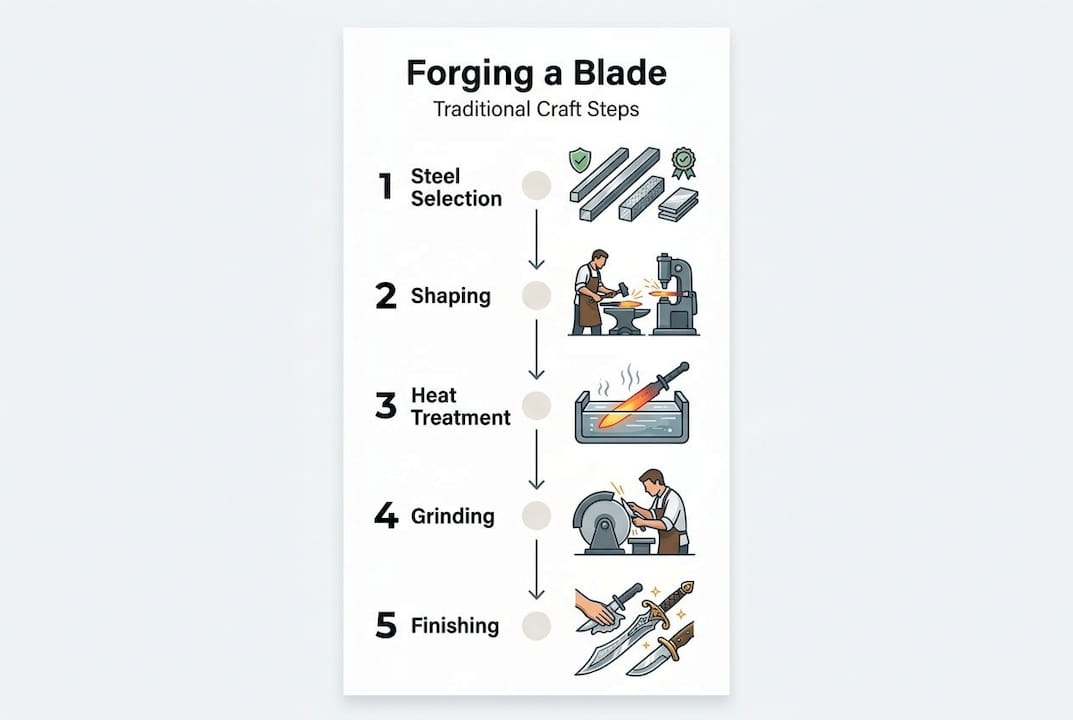
The process is sequential and unforgiving. A mistake at step two can compromise the entire blade at step seven. Here is the core workflow most bladesmiths follow:
- Steel selection: Choose the appropriate alloy. High-carbon steels like 1075, 1084, or O1 tool steel are common for knives and swords because they respond well to heat treatment. The conversion of raw iron and steel into a performance-ready blade structure depends entirely on getting the metallurgy right from the start.
- Heating: Place the steel in the forge (coal, gas, or propane) and bring it to forging temperature, typically between 1,900°F and 2,300°F (about 1,040°C to 1,260°C). Color is a reliable visual guide: bright orange to yellow indicates workable temperature.
- Forging the shape: Using a hammer and anvil, the bladesmith draws out the steel, creating the basic profile of the blade. This includes thinning the steel toward the edge, establishing the taper, and roughing out the fuller (the groove running along some blades that reduces weight without sacrificing strength).
- Forge-welding and pattern-welding: For Damascus-style blades, the bladesmith stacks and welds multiple pieces of steel with differing carbon contents. They fold and weld these layers repeatedly, sometimes 50 to 300 times, creating the distinctive wavy or flowing patterns. This step demands the highest forge temperature and the most precise hammer control.
- Normalizing: The blade is cycled through several rounds of heating and air cooling to relieve internal stresses built up during forging. Skip this, and the blade is prone to warping or cracking later.
- Profiling and grinding: The rough-forged blade is refined with angle grinders and belt grinders, establishing the precise bevel geometry, tip shape, and edge thickness.
- Heat treatment (quenching and tempering): This is the most critical stage. The blade is brought to its hardening temperature and then quenched (plunged into oil, water, or brine) to lock in hardness. The importance of heat treatment cannot be overstated: thermal discipline at this stage determines whether the blade becomes legendary or useless. After quenching, the blade is tempered at a lower temperature (often 375°F to 450°F) to reduce brittleness while retaining hardness.
- Finishing: Final grinding, hand sanding through progressive grits, and polishing bring the blade to its finished appearance. Then comes handle fitting, guard installation, and sheath fabrication.
| Stage | Key action | Primary risk if skipped |
|---|---|---|
| Steel selection | Choose correct alloy | Poor edge retention or brittleness |
| Normalizing | Stress relief cycles | Warping during heat treatment |
| Quenching | Rapid cooling to harden | Blade stays too soft |
| Tempering | Controlled reheat | Blade becomes too brittle |
| Final finishing | Grinding and polishing | Surface defects and weak spots |
Controlling heat-treatment steps like quenching and tempering is where a bladesmith's knowledge of metallurgy becomes as important as their hammer skill. You can forge a perfect shape and still ruin the blade completely in those final minutes of heat work.
Pro Tip: Water quenching produces a harder blade but dramatically increases the risk of cracking. Oil quenching is slower but far more forgiving, which is why most modern bladesmiths default to it unless a specific steel demands otherwise.
Bladesmiths in weapon production: Collaboration, rivalry, and specialization
The solo image of a lone bladesmith working in isolation is compelling, but in reality, weapon making has always included collaboration and competition at every level of the craft.
Medieval European bladesmithing operated within guild systems, which were professional organizations that set quality standards, controlled training, and managed trade. Guilds created official distinctions between craft specializations. A swordsmith was not the same as a general bladesmith, and certainly not the same as an arrowhead maker or a cutler (someone who makes cutlery). Historical European practice involved specialization and disputes between swordsmiths and makers of similar weapon types, sometimes leading to formal legal complaints about guild boundary violations.
The distinctions mattered economically. A bladesmith making agricultural tools occupied a different market than one producing military swords for noble clients. Here is how the main categories compared historically:
| Specialization | Primary products | Typical clientele | Defining technique |
|---|---|---|---|
| Swordsmith | Long swords, sabers, rapiers | Military, nobility | Complex geometry, differential hardening |
| Knifemaker or cutler | Knives, daggers, eating tools | General public, merchants | Stock removal, handle crafting |
| Armorer | Plate armor, chainmail | Military, nobility | Sheet forming, riveting |
| General bladesmith | Mixed blade types | Varied markets | Forging, heat treatment |
These specializations were not purely cooperative. Guilds sometimes went to court over who had the right to produce specific weapon types. A swordsmith guild might argue that a bladesmith producing short swords was violating their exclusive rights. These disputes drove innovation as craftsmen pushed the limits of what their category could include.
"The quality of a blade is the sum of its maker's decisions, not just the material. Every step from forge to finish carries the maker's judgment."
Modern parallels are easy to find. Custom weapon makers compete fiercely for recognition at bladesmithing competitions, forge-ins, and collector markets. You can see this dynamic playing out in the demand for accurate medieval sword styles where a maker's reputation for specific techniques (like differential hardening on a katana) determines their standing in the community.
What specialization ultimately produces is quality through focus. A maker who dedicates years to one weapon type, say the Roman historical gladius swords, develops an intuitive understanding of that weapon's geometry, weight distribution, and intended use that a generalist simply cannot match.
- Focused specialization accelerates skill development in specific blade geometries.
- Guild systems, while restrictive, ensured minimum quality standards across regions.
- Rivalry between specialists pushed technological improvements in steel and technique.
- Collaboration was also real: bladesmiths often purchased raw materials from ironmongers and sold finished blades to cutlers for handle work.
Bladesmiths today: Influence on collectors, cosplay, and popular culture
Having explored the traditions and rivalries of historical bladesmithing, let's see how this ancient craft continues to shape modern weapon collecting and fandom in genuinely meaningful ways.
Modern bladesmithing blends tradition with new methods, and this hybrid approach is exactly what appeals to today's collectors and pop culture enthusiasts. A collector buying a hand-forged Damascus sword isn't just purchasing a decorative object; they're acquiring evidence of a specific skill set that took years to develop. That distinction matters enormously in the collector market.
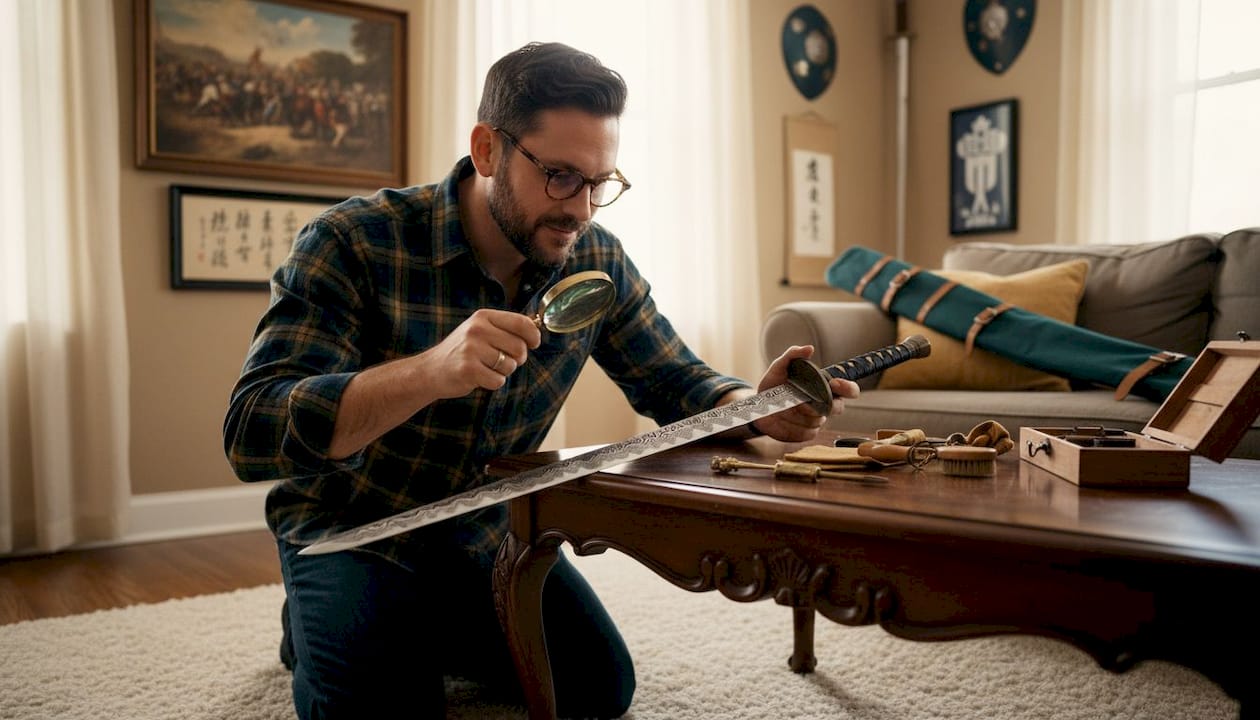
The cosplay and fantasy weapon community has added a fascinating new dimension to bladesmithing demand. Screen-accurate replicas of weapons from games, films, and anime require bladesmiths who understand both historical technique and modern aesthetics. A sword from a fantasy setting might combine elements of five different historical periods into a single fictional design. Making that design functional (or at least convincing) while maintaining structural integrity requires real bladesmithing knowledge.
Here's how bladesmiths are influencing modern collector and cosplay culture right now:
- Authenticity is the primary value driver. Collectors consistently pay more for hand-forged pieces over machine-made reproductions because the variation and craft marks are proof of human skill.
- Safety in cosplay weapons depends on bladesmith knowledge. A poorly heat-treated blade can snap unexpectedly. Proper tempering ensures that even a display sword won't shatter dangerously if mishandled.
- Pop culture partnerships are growing. Licensed replicas of weapons from major franchises are increasingly produced by skilled bladesmiths rather than mass manufacturers, raising the quality baseline.
- Investment value is real. Hand-forged blades by recognized makers often appreciate in value, functioning more like art objects than consumable products.
- Community-driven custom orders are rising. Enthusiasts who want a custom Spatha replica with personalized engraving or specific steel choices now drive a significant portion of a custom bladesmith's business.
The demand for authenticity is not just a trend. It reflects a broader cultural shift toward valuing tangible craft in a world saturated with mass-produced objects. When someone holds a properly forged blade, the weight, the balance, and the surface texture communicate something that a catalog image never can.
Why true mastery in bladesmithing is overlooked
Here's what most discussions about bladesmithing get wrong: they focus on the dramatic parts. The flying sparks, the glowing steel, the hammer blows. The invisible work, the part that separates a competent smith from a true master, happens inside the steel where no one can see it.
Thermal control during heat treatment is an exercise in microstructure management. When you quench a blade, you're not just making it hard. You're forcing a phase transformation in the steel's crystalline structure, converting austenite into martensite. The speed of that transformation, and how evenly it occurs across the blade's cross-section, determines whether the blade holds an edge under stress or chips and cracks unpredictably. Most collectors and even many enthusiasts never think about this because you can't see martensite with the naked eye.
We think this invisibility is why bladesmithing mastery gets chronically undervalued. People judge blades by surface finish, pattern aesthetics, and handle quality. Those things matter, but they're the visible 20 percent. The structural soundness that comes from correct thermal discipline is the hidden 80 percent that determines whether a blade is genuinely excellent or just attractive.
Modern bladesmiths are also active innovators, not just preservationists. They adapt historical alloys to contemporary materials, experiment with hybrid quenching media, and apply computer-aided metallurgical analysis to traditional forge workflows. Looking at the craftsmanship in a custom battle sword today, you're seeing the product of both medieval tradition and 21st-century materials science working together.
The deeper truth is that bladesmithing is one of the few remaining crafts where science and intuition must coexist. No thermometer replaces the experience of watching steel color shift in a dimly lit forge. No formula substitutes for knowing how a specific piece of steel will move under a specific hammer weight. That combination of measurable knowledge and irreplaceable feel is what makes master bladesmiths genuinely rare, and genuinely worth understanding.
Bring swords and bladesmithing art into your collection
If you've gained a new appreciation for what goes into a well-made blade, you may want to experience the difference firsthand. Seeing a hand-forged sword in person changes your understanding of the craft completely.
At TopSwords, every blade in the catalog reflects the techniques covered in this article, from Damascus pattern-welding to precise heat treatment and expert finishing. Whether you're building a serious collector's display, sourcing an accurate cosplay weapon, or searching for a one-of-a-kind gift, the selection spans historical replicas, fantasy designs, and custom Damascus pieces. Customization options including engraving are available, so your blade can carry a personal mark alongside the smith's. Explore the full range and find a blade that represents the craft the way it deserves to be represented.
Frequently asked questions
What is the difference between a bladesmith and a swordsmith?
A bladesmith works across all blade types including knives, daggers, and swords, while a swordsmith specializes specifically in swords, often following a dedicated historical tradition tied to a specific culture or sword type.
Why is heat treatment important in weapon making?
Heat treatment determines a blade's final hardness, edge retention, and resistance to breakage. Controlling quench and temper steps directly sets whether a blade performs reliably under real stress or fails at a critical moment.
Are handmade blades better than machine-made ones?
Handmade blades give the maker direct control over material quality, geometry, and thermal processing at every step. Modern bladesmithing blends tradition with skill in ways that mass production physically cannot replicate, making hand-forged pieces superior for collectors who value authentic performance and craftsmanship.
What techniques do bladesmiths use to combine different steels?
Bladesmiths use forge-welding and pattern-welding to stack, heat, and hammer-weld plates of different steel types together, creating blades with layered visual patterns and a combination of hardness and toughness that single-steel blades cannot always achieve.