
Most collectors spend hours examining blade finish, edge geometry, and steel composition. It's easy to obsess over what you can see. But the part that actually determines whether a sword holds together under stress or falls apart in your hands is hidden inside the handle. The tang, the unsharpened extension of the blade that runs into the hilt, is the silent backbone of every sword ever made. Understanding it changes the way you evaluate, buy, and appreciate any piece in your collection. This guide covers what a tang is, why it matters, how to identify different types, and what it all means for collectors who take craftsmanship seriously.
Table of Contents
- What is a sword tang? The hidden foundation of every blade
- Sword tang types: Comparing full, partial, rat-tail, hidden, and tapered tangs
- How the tang influences sword value, authenticity, and performance
- Evaluating tangs: Practical tips for buyers and collectors
- Why tang obsession is justified: A collector's viewpoint
- Find your next collectible sword with the perfect tang
- Frequently asked questions
Key Takeaways
| Point | Details |
|---|---|
| Tang defines strength | The sword tang is the main backbone providing structural support and durability to every sword. |
| Type affects purpose | Full tangs are best for functional swords, while rat-tail and hidden tangs are more suited to decorative or balanced pieces. |
| Collector value impact | Tang style can greatly influence a sword's authenticity, value, and practical use for collectors. |
| Inspect before buying | Evaluating the tang is essential to avoid disappointment in quality, longevity, or investment. |
What is a sword tang? The hidden foundation of every blade
The blade is what everyone sees. The tang is what makes the blade worth owning. Before we go further, let's make the definition clear: a sword tang is the unsharpened extension of the blade that extends into the handle (hilt), providing structural integrity and securing the hilt components.
Think of the tang as the root of a tooth. You never see it, but without it, the whole structure fails under pressure. When you swing or handle a sword, every ounce of force travels through the blade and straight into the tang. If the tang is poorly made, too short, or too thin, that energy has nowhere to go except into a catastrophic failure, usually at the worst possible moment.
Historically, bladesmiths from medieval Europe to feudal Japan understood this instinctively. The construction of sword tang types varied by region, era, and intended use, but the principle stayed the same: the tang had to be strong enough to anchor the entire hilt assembly. Crossguards, grip material, and pommel all rely on the tang for their stability.
Here is what a well-designed tang actually does for a sword:
- Transfers energy efficiently from blade to grip, reducing hand shock
- Anchors hilt components so crossguard and pommel don't rattle or shift
- Distributes stress along the full length of the handle instead of concentrating it at one point
- Determines balance because the tang's weight and length shift the sword's center of gravity
- Signals quality to experienced collectors who know what to look for
"The tang is not a secondary feature. It is the structural spine of the sword. Its quality, length, and fit within the handle tell the entire story of how a smith approached the build."
For collectors, the tang is also a marker of authenticity. A reproduction sword with a poorly fitted tang will feel loose, hollow, or unbalanced in ways that are immediately obvious once you know what to notice. Conversely, a sword with a properly fitted tang feels like a single, unified object, solid and intentional from tip to pommel.
Understanding the tang also helps you spot overpriced decorative pieces disguised as functional swords. Sellers rarely advertise weak tang construction because it instantly signals low build quality. That's exactly why you need to know what questions to ask.
Sword tang types: Comparing full, partial, rat-tail, hidden, and tapered tangs
Common tang types include full tang (strongest for combat), partial or rat-tail tang (weaker, decorative), hidden tang (concealed for aesthetics and balance), and tapered tang (reduces weight, allows flex). Each has a distinct role and a different audience.
Here is how each type breaks down:
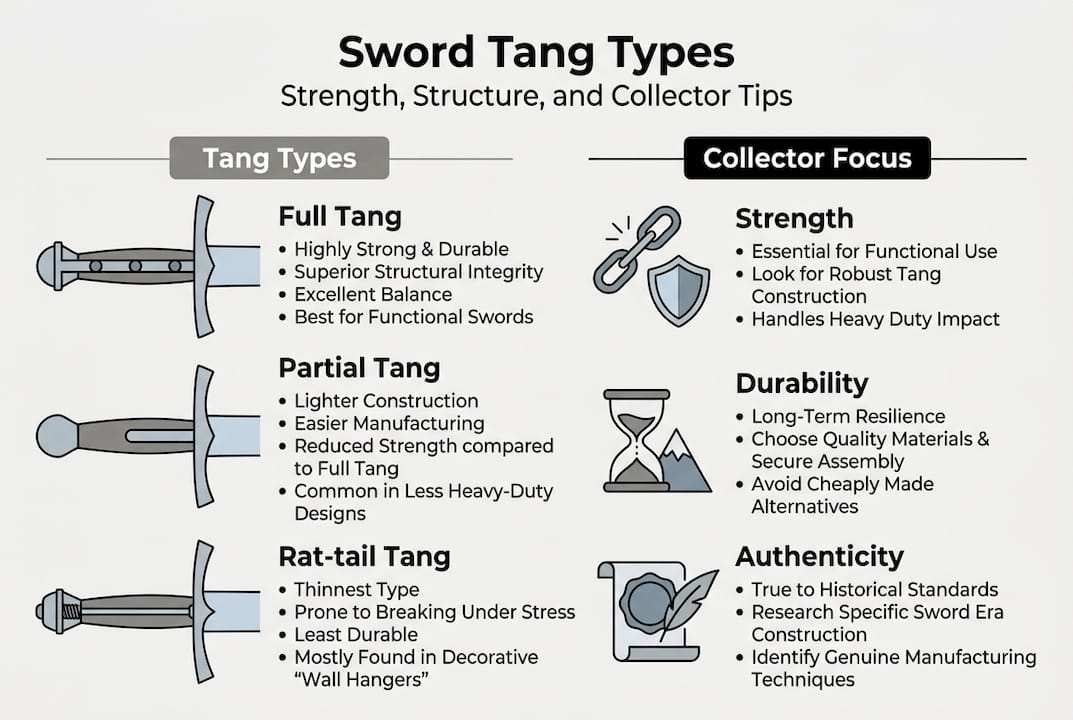
- Full tang runs the complete length and width of the handle, often visible along the handle's edge with grip slabs attached on either side. Maximum strength, maximum reliability.
- Partial tang extends only partway into the handle. Weaker than a full tang and susceptible to snapping under stress.
- Rat-tail tang is a narrow rod welded or attached to the blade base and threaded through the handle. Common in cheap imports and wall-hanger pieces.
- Hidden tang is a narrower extension that fits completely inside the handle material, often used in Japanese swords and certain European designs for a clean aesthetic.
- Tapered tang narrows progressively as it moves through the handle, reducing tip weight and enabling a more dynamic balance point.
| Tang type | Structure | Strength | Best use case |
|---|---|---|---|
| Full tang | Full width through handle | Highest | Combat, heavy use, serious collecting |
| Partial tang | Partial length, reduced width | Moderate | Light use, some decorative pieces |
| Rat-tail tang | Narrow rod, often welded | Lowest | Display only, decorative wall pieces |
| Hidden tang | Narrow, fully enclosed | Moderate to high | Aesthetics, balanced display swords |
| Tapered tang | Narrows toward pommel | High with flex | Period-accurate replicas, handling swords |
For collectors prioritizing durability and long-term value, full tang swords are the standard to seek. They offer the most honest representation of how a working sword was actually built. If you want something closer to period accuracy with clean lines, a hidden tang piece has its own appeal.
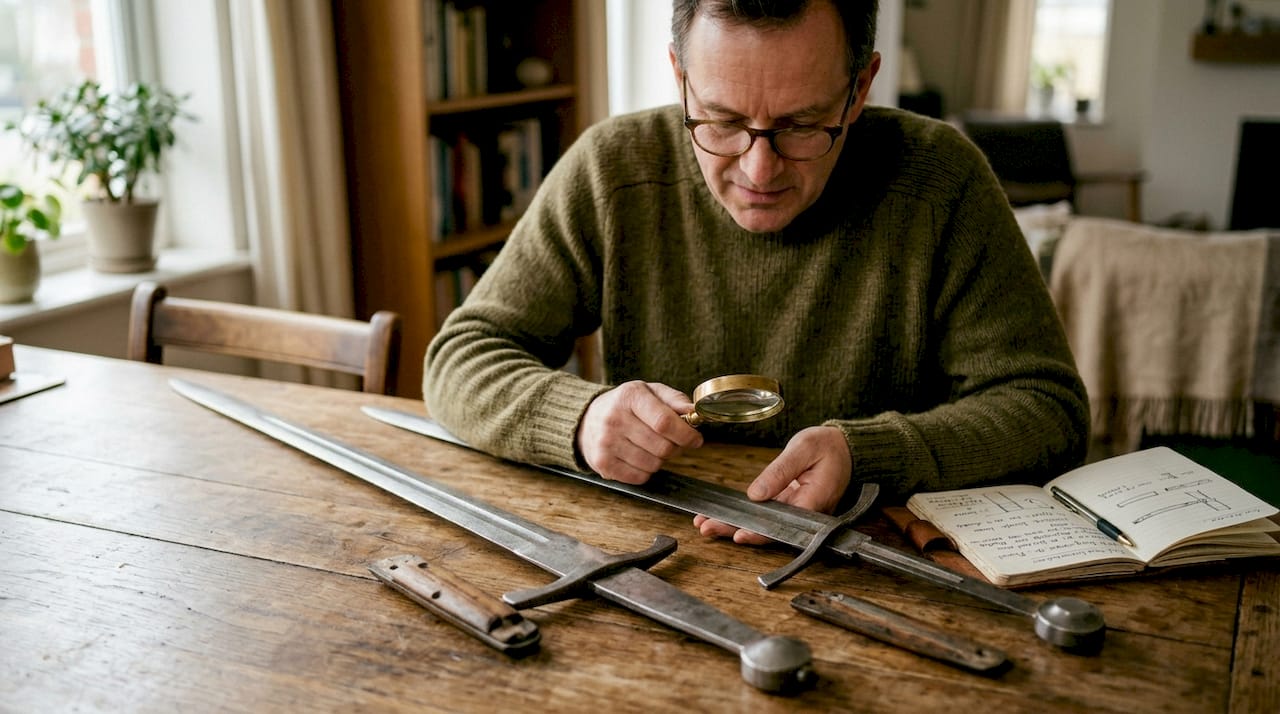
Avoid rat-tail tang swords for anything beyond display. They exist primarily as a cost-cutting measure and should never be handled with force.
Pro Tip: Hold the sword and tap the pommel lightly with your palm. A full tang sword produces a solid, unified sound and minimal vibration. A rat-tail tang piece often resonates with a hollow, loose feeling that gives it away immediately.
How the tang influences sword value, authenticity, and performance
Tang type directly impacts structural integrity and suitability for combat or display. But it also shapes a sword's story in ways that go well beyond function.
Museums and authentic smiths pay close attention to tang construction because it reveals the smith's intent and skill. A well-peened full tang, where the end of the tang is hammered to lock the pommel in place, is a hallmark of genuine medieval construction. You see this on pieces in the Wallace Collection and similar armories worldwide. It is not decorative. It is engineering.
Here is what tang construction affects for collectors:
- Durability: A full tang sword, properly fitted, can last generations. A rat-tail tang may fail within years of regular handling.
- Resale value: Experienced buyers consistently pay more for swords with verifiable full tang construction. Tang type is a primary factor in secondary market pricing.
- Safety: A weak tang is a liability. Handle failures can cause serious injury, especially with any kind of cutting or sparring use.
- Historical authenticity: Period-accurate swords used specific tang styles. A Viking sword with a rat-tail tang is immediately disqualified as a serious replica.
- Balance and feel: The tang's weight distribution changes where the sword balances, directly affecting how it handles in the hand.
| Sword type | Traditional tang style | Collector priority |
|---|---|---|
| Medieval longsword | Full tang, peened pommel | Authenticity, structural integrity |
| Japanese katana | Hidden tang, pinned mekugi | Period accuracy, aesthetic |
| Roman gladius | Full tang, riveted grip scales | Durability, historical accuracy |
| Renaissance rapier | Tapered or full tang | Balance, handling refinement |
For collectors drawn to ornate display pieces, a hidden tang collector sword can offer beautiful aesthetics while still maintaining solid construction when built by a skilled maker. The key is understanding what you are buying and why.
Evaluating tangs: Practical tips for buyers and collectors
Recognizing tang type and craftsmanship secures the hilt and optimizes sword longevity. Here is a step-by-step approach for evaluating any sword before it joins your collection.
- Check the handle edges. On a full tang sword, you can often see a thin line of metal running along the side of the grip where the tang meets the handle scales. If the handle is a single piece of material with no visible metal, you are likely looking at a hidden or rat-tail construction.
- Inspect the pommel. A peened pommel, where the tang end is visibly mushroomed over the pommel, indicates traditional full tang construction. A threaded nut or hidden connection may suggest rat-tail.
- Feel for movement. Grip the handle firmly and apply gentle torque in opposing directions. Any looseness, creaking, or shifting between the blade and handle is a red flag.
- Check the balance point. A full tang katana or longsword typically balances a few inches from the crossguard. An unusually blade-heavy sword can indicate a thin, lightweight tang that adds no counterbalance.
- Ask the seller directly. Reputable makers and dealers will tell you the tang type without hesitation. Vague answers or deflection are warning signs.
- Research the manufacturer. Known brands and established smiths document their tang construction. If a product listing doesn't mention tang type at all, that is a clue worth paying attention to.
Pro Tip: For decorative pieces you plan to display and never handle, tang type matters less for safety but still matters for long-term stability. A poorly fitted tang can cause handle pieces to shift or loosen over years of display, especially in changing humidity or temperature environments.
Common pitfalls include buying "battle-ready" labeled swords at suspiciously low prices. No sword built with full tang construction and quality steel can be produced cheaply. If the price seems too good, the tang is probably the first place corners were cut.
Why tang obsession is justified: A collector's viewpoint
Conventional sword collecting wisdom tells you to evaluate steel quality, edge geometry, and finish first. We think that gets the priority order backwards.
The tang is the first thing we look for now, and it changed everything. Early on, a visually striking replica sword with a gorgeous Damascus pattern and an ornate crossguard turned out to have a rat-tail tang barely wider than a pencil. It looked incredible on a stand. The moment it was handled with any force, the handle shifted. That sword went from prized display piece to cautionary tale fast.
Here is the uncomfortable truth: a sword with a mediocre blade and a masterfully constructed full tang will outlast and outperform a visually stunning sword with a weak tang every single time. The tang is the long game. It is what separates an heirloom piece from a decoration that degrades with every decade.
Don't judge by appearance alone. The next time you consider a sword, ask about the tang first. If the answer is vague, keep walking.
Find your next collectible sword with the perfect tang
At TopSwords, craftsmanship starts from the inside out. Every piece in the collection is selected with tang construction, blade integrity, and long-term collector value in mind.

Whether you are looking for a custom handmade battle sword with a full tang built to last generations, or a full tang katana that balances period accuracy with modern craftsmanship, we have options that reward the discerning collector. Explore the full range of sword tang options across styles, periods, and steel types. You now know what to look for. Let that knowledge guide your next acquisition.
Frequently asked questions
What is the strongest type of sword tang?
The full tang is strongest and most reliable for combat and heavy handling, running the full length and width of the handle for maximum structural integrity.
How can I tell if a sword has a full tang?
A full tang runs the entire length of the handle and is often visible as a thin metal line along the grip edges, with handle scales attached on both sides.
Are rat-tail tang swords safe for practice or combat use?
No. Rat-tail tangs are weaker and are strictly for decorative display. Using one for any functional handling creates a genuine risk of handle failure and injury.
Why do some collectors prefer hidden tang or tapered tang designs?
Hidden and tapered tangs prioritize aesthetics and balance, making them well suited for display or period swords where handling feel and visual style outweigh raw structural strength.